in this article
- Who Was Jean-Paul Sartre?
- What is Mescaline?
- Sartre’s Bad Trip
- Mescaline and Existentialism
- Nausea
- Being and Nothingness
- Conclusion
Are you 18 or older?
Please confirm that your are 18 years of age or older.
You are not allowed to access the page.
Disclaimer: The views and opinions expressed in this article are those of the authors and do not necessarily reflect the official policy or position of Chemical Collective or any associated parties.
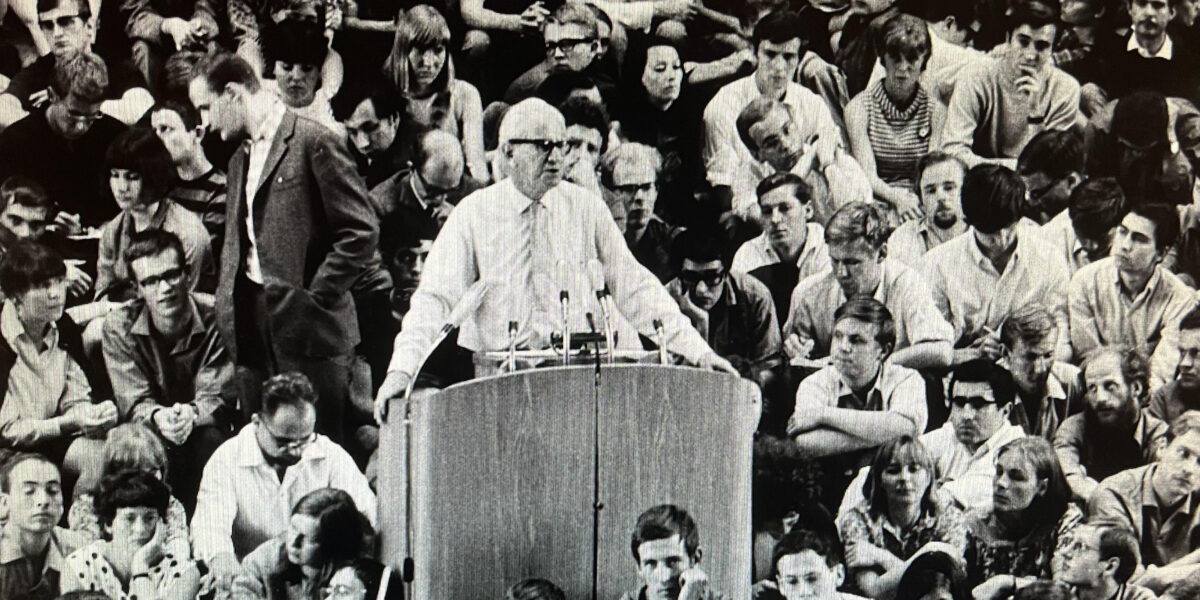
In Paris, in 1935, a young philosopher from the Husserlian school of thought received a mescaline injection from his friend, the psychiatrist Daniel Lagache. Lagache played a role of prime importance in the development of psychoanalysis and philosophical discourse at this time. And the young philosopher? None other than Jean-Paul Sartre, one of the most influential thinkers of the 20th century, and soon to be a proponent of the philosophy of existentialism. On receiving the injection, Sartre’s hopes of an enlightening, positive experience, designed to expand his consciousness, quickly deteriorated into a horrific ordeal. Later in life, Sartre described some terrifying details of the lasting effects of the trip:
“I started seeing crabs around me all the time… They followed me into the street, into class”
Sartre described how the hallucinations continued, well after the experience concluded. He described waking up and conversing with the creatures before class:
Even more troubling, if that were possible, were the effects on the surrounding world. Houses were distorted and imposing, ordinary household objects like clocks and umbrellas would morph and change shape, taking on the form of animals. The ordinary world had become an uncanny, unfamiliar place. Unsurprisingly, the intensity of these effects on Sartre’s conscious experience quickly spiralled, and what had initially amounted to an academic experiment became a nervous breakdown. This experience would go on to affect the young philosopher for the rest of his life, actively shaping his worldview, his lived experience, and therefore his entire philosophical trajectory. The power of a single mescaline trip on one single individual played a huge role in the development of the philosophy of existentialism, which continues to have an impact on us today.
His literary debut, Nausea (1938), reflected the visceral terror of this experience. In Being and Nothingness (1943), the intellectual backbone of the philosophy of existentialism begins to take shape, grounded in his fractured perception following his mescaline experience.
However, this being Chemical Collective, not Philosophy Now, I think prior to us diving headlong into the effects of mescaline on the evolution of Sartre’s developing philosophy, and its continuing cultural impact, we should rewind and discuss the man himself prior to his encounter with the powerful psychedelic.
Jean-Paul Sartre was born in Paris on June 21, 1905, to Jean-Baptiste, an ensign in the French navy, and Anne-Marie Sartre, the daughter of a prominent liberal family with a relation to Nobel Peace laureate and famed humanitarian Albert Schweitzer. His father was away overseas for the birth, and contracted a fever which he succumbed to just a year following Sartre’s birth. Sartre is known to have, rather unsympathetically, described this as an illustration of his father’s “good manners”, as his untimely death left Sartre without a superego (self-critical conscience). He was raised and educated in Paris, where he would reside for much of his life.
Sartre graduated in philosophy in 1928, as a proponent of the Husserlian school of thought. Husserlian philosophy, developed by the prominent thinker Edmund Husserl, deals with what is called “phenomenology”, which describes phenomena (literally, things, or things that happen) as distinct from being itself. Simply put, this means that all meaning and value are not inherent to an object/occurrence but rather the lived, human experience of the object/occurrence. You can begin to see here how the confluence of this route of philosophical enquiry and the effects of mescaline on conscious might create a perfect existential storm for the young philosopher to tackle.
Though oddly, he failed on the first attempt, Sartre successfully qualified to teach philosophy. Following this, he undertook an 18-month tour of military service as a meteorologist. This concluded in 1931, at which point he began teaching philosophy at the lycée (high school) in Le Havre. Between 1933-34, he was accepted for a research fellowship in Berlin for further, more in-depth study of the Husserlian philosophy of phenomenology. It was the following year, 1935, when the promising young philosopher encountered mescaline, and his world changed.
Mescaline is a naturally occurring alkaloid found in a variety of cacti, which is traditionally associated with the Peyote cactus. It is one of the earliest known hallucinogens, with evidence of human use stretching back 5,700 years. The pharmacology of mescaline is very similar to that of other classic psychedelics such as LSD and magic mushrooms. I won’t go in-depth into the science here; Debra Wilkinson’s article on sacred cacti does a good job of summarising that information if you would like to read further. Suffice to say, the effects of mescaline are powerful enough to have had a profound impact on the life of Jean-Paul Sartre.
Sartre was injected with mescaline as a means to directly research Husserl’s philosophy of phenomenology, taking to heart Husserl’s assertion that “a new way of looking at this was necessary.” Mescaline was the perfect vehicle to fully explore phenomenology’s aim – to describe reality purely as perception, unattached to any prior theories, preconceptions, categorisations, and definitions. The theory was that by harnessing psychedelics’ ability to detach us completely from our usual relationship with reality and all it encompasses, Sartre would be able to better understand, viscerally, Husserl’s dictum to go back “to the things themselves.”
Much of the peyote/mescaline-related literature at this time reflected this potential, with writers able to simply describe its visions and sensations without imposing definition or meaning on them. This was phenomenological discourse prior to the term even existing, and a root cause of Sartre’s motivation for self-experimentation.
Though Sartre wrote little explicitly about the experience, some small snippets found their way in L’imaginaire, his 1940 study of the phenomenology of the imagination. He wrote that he found it “inconsistent and mysterious”. It was impossible to be a spectator of his experience any longer; it distorted everything. He was drowned in a wash of uncontrollable sensations, overstimulated to the point of disgust. Aside from this, he provided little in the way of concrete details himself, with the best-known account of his experience coming from an anecdote from Sartre’s close friend Simone de Beauvoir. She was the first to describe his encounters with crab-like creatures, following him in his peripheral vision, never quite clear, elusive and sinister. These encounters went on for many weeks following the trip itself, and even though he was aware they were imaginary, their continued presence drove him into a six-month-long depression, which culminated in a nervous breakdown.
After the experience, it was Simone de Beauvoir who arranged psychiatric assistance for Sartre from the controversial psychoanalyst Jacques Lacan. Lacan’s main theory was that the human mind is structured by language and symbolism, a somewhat adjacent position to Sartre’s burgeoning philosophy. While Sartre described the assistance from Lacan as “nothing that he or I valued very much”, they were able to conclude that the crabs were potentially a symbolic representation of his fear of becoming alone. Sartre said that “the crabs really began when my adolescence ended”, raising the possibility that their continued existence was solely as a product of his experience.
Even though mescaline, as with the vast majority of psychedelics, is known to be a remarkably safe compound, if Sartre had any latent psychological issues, he was unaware of, there is every chance that it was the catalyst for revealing them.
Following on from his encounter with Lacan and their conclusion on the symbolism of the crabs, they vanished. They had been with him for so long that he actually felt a sense of loss when they disappeared. Sartre later admitted a strange kind of conflicted enjoyment of the experience: “I liked mescaline a lot… the mountains take on so many colours,” but admitted that it left him utterly terrified for a prolonged period.
Though the crabs themselves had disappeared, hallucinations lingered on well into his later years, reappearing in moments of stress or loneliness. Mescaline did more than scare Sartre. It completely collapsed his belief in perceptual certainty (the individual experience of reality) and shifted his intellectual interest away from the abstract notion of phenomenological discourse to an exploration of the horrific reality of the lived experience of freedom at the heart of our reality.
An extremely unimpressed Simone de Beauvoir believed Sartre’s consumption of mescaline to be misguided. She believed he had placed himself in a position where he forfeited control over his own thoughts, which negated what it meant to be an intellectual. Ironically, Sartre’s developing theories very much agreed with this idea of a lack of control over one’s thoughts, but they posited that that was simply the reality of human existence as a whole.
This YouTube video from the BBC, wonderfully narrated by Stephen Fry, provides a detailed explanation of Sartre’s conception of existential choice.
To summarise, though, the concept is: we are pushed into existence against our will, and once we arrive, we have to make choices. We cannot avoid creating ourselves, no matter how limited the options; there is no way to opt out. Even not making choices is a choice.
“According to Sartre, there is no design for a human being,” says Fry, in the video, co-opting Sartre’s famous phrase: “existence precedes essence.”
We simply arrive in a world with no plan, no consensus of what it means to be human, and yet have to make endless choices and decisions that have a tangible impact. The absurdity of having little to no control over the decisions we make, why we make them, and the potential weight these decisions have on individuals and the future is the root of Sartre’s philosophy.
I’m sure those of you with prior experience of psychedelics will recognise some of these thought-trains the young philosopher travelled down, especially the detachment from our prior cultural biases or experiences. The separation from self, to a position from which you actually see the complete lack of grounding beneath how and why you act the way you do in the world, can be a scary realisation.
For me personally, it was a profound alteration of how I see myself and the world, and the perceived, seemingly self-evident, separation between the two.
To further enlighten us as to the powerful effects mescaline had on Sartre’s conception of existentialism, let’s first consider two of his most well-known works: his debut novel, Nausea, and his true magnum opus, Being and Nothingness.
While not explicitly about Sartre’s mescaline experience, Nausea is written in the form of a diary of a historian named Antoine Roquentin. It relates his growing sense of alienation from the world, as he becomes progressively aware of its innate strangeness. Sounds somewhat familiar. In one of the most vivid passages, Roquentin recalls looking at his hand:
The image of the crab here appears to directly reflect the hallucinations Sartre encountered after consuming mescaline: stalking him through his day-to-day and into his writing. Critics confirm this link between the protagonist and Sartre himself:
The nausea Roquentin experiences throughout the narrative does not stem from illness; it is a direct result of seeing and feeling the lack of solidity of reality. Objects and people are not stable; they teem with “vicious masses”, endless associations and interrelations. Nausea doesn’t just theorise freedom as a concept, it forces its weight upon the reader:
Scholars describe Nausea as a novel born from crisis, in which lived experience, dissolved by mescaline, becomes the ground for powerful philosophical insights. In transforming his nervous breakdown into literature, Sartre is able to help the reader to actually see the genuine lack of underpinning of our day-to-day, and forces you to feel the terror, disgust and existential dread that this can foster. It is the intensity of feeling that allows you to truly grasp the concept of existentialism and make it tangible.
Subtitled “A Phenomenological Essay on Ontology”, Being and Nothingness is seen as Sartre’s magnum opus. It is a characteristically dense work, which investigates the structures of consciousness, embodiment, and freedom – all concepts touched upon but far from explained in Nausea, which resonated ever more deeply following Sartre’s experience with mescaline and subsequent breakdown.
At the heart of Being and Nothingness is the concept of “intentionality”. Intentionality explains consciousness as always “of something”, meaning it is never a separate space, in and of itself, but rather a result of and an intrinsic element of absolutely everything else. Mescaline showed Sartre that perception isn’t infallible; it can be distorted and dramatically altered. Think of the objects he described as morphing and taking on the form of animals. The fact that you cannot trust your senses, and consciousness does not just open up or reveal the world as it truly is, underpins Sartre’s philosophy.
He illustrates this concept in the “The Body” chapter of Being and Nothingness. The body, unsurprisingly, is a philosophical puzzle for Sartre. He argued that to understand what it is to be an embodied individual, we must first understand that the body is not simply a physical object or mechanism. It is a lived, subjective experience inseparable from consciousness itself. He breaks the embodied experience down into three elements:

Scholars like Dermot Moran argue that this is revolutionary – the body formulated as the link between consciousness and the world, the subjective and objective. A link that was exposed by the use of a psychedelic. When taken alongside the powerful emotional response Nausea promotes, the philosophical importance of this becomes apparent. If this link between subjective and objective becomes distorted, the risk of a collapse of meaning, of reality itself, is real and tangible.
ACCESS THE FULL TEXT OF “BEING AND NOTHINGNESS” HERE
To sum up Sartre’s post-mescaline philosophy, we can say that the overarching theme is the fragility of our experience of the world. But it is this fragility that makes us terrifyingly free. Once we are aware that “meaning” is not inherent to anything at all and we are ourselves the creators and curators of meaning, the body ceases to be a mechanical object our consciousness resides in. It is the means by which our awareness struggles to maintain our reality. “Existence precedes essence” is not just a philosophical concept; we live through it every day.
Jean-Paul Sartre’s mescaline experience and its resulting effects on his psyche shaped his philosophy and work for the rest of his life. He did not simply present abstract ideas; he related raw, personal experiences illustrating these ideas. His confrontation with terror and the terrifying malleability of reality, revealed by mescaline, allowed him to ground his philosophy in the lived experience of the disintegration of his mind.


In the modern day, with the psychedelic renaissance in full swing, Sartre’s experience can provide insight, but also serve as a warning. Mescaline plunged him into the depths of existential dread, which, while enlightening, was by all accounts one of the most difficult experiences of his life. Modern users of psychedelics are often seeking therapeutic or transformative insight. Sartre’s difficulties can serve as a reminder that dismantling perception can have far-reaching effects that linger on way beyond the conclusion of a psychedelic experience.
Contemporary, qualified practitioners of psychedelics emphasise the importance of “set and setting”, integration, and psychological support before, during, and after an experience. This ensures that these incredibly powerful altered states are navigated with the due care and consideration they deserve.
Sartre did not return from the trip with a grand revelation of interconnectedness and harmony – far from it. Existentialism was born through terrifying, psychedelic-induced hallucinations. It does not offer comfort, just the clarity of knowing that at the most fundamental level, we are ourselves individually responsible for shaping our own meaning.
David Blackbourn | Community Blogger at Chemical Collective
David is one of our community bloggers here at Chemical Collective. If you’re interested in joining our blogging team and getting paid to write about subjects you’re passionate about, please reach out to Sam via email at samwoolfe@gmail.com
Welcome to Chemical Collective.
Create an account to earn 200 welcome points.
Already have an account? Sign in
Check out our Community Blog and get involved with the conversation. You will be awarded 50 x ChemCoins for each comment up to a limit of 250 total ChemCoins.
Have you purchased any of our products? Reviews and reports are so important to the community. Share your honest opinion, and we’ll reward you with 50 ChemCoins for each review!
Every time you complete an order with us, you’ll be awarded ChemCoins for each Euro spent.
Welcome to Chemical Collective.
Create an account to earn 200 welcome points.
Already have an account? Sign in
Earn commission every time someone makes a purchase through your link.
When you become an affiliate, you will be allocated a unique link to share with your friends, followers, subscribers, or Aunt Susan.
You can choose to payout the commission earned once per month, or save it up to receive on a rainy day! Commission earned is 5% of the total order value per referral.
Contact us to join the Chemical Collective family and become an affiliate.
share your toughts
Join the Conversation.