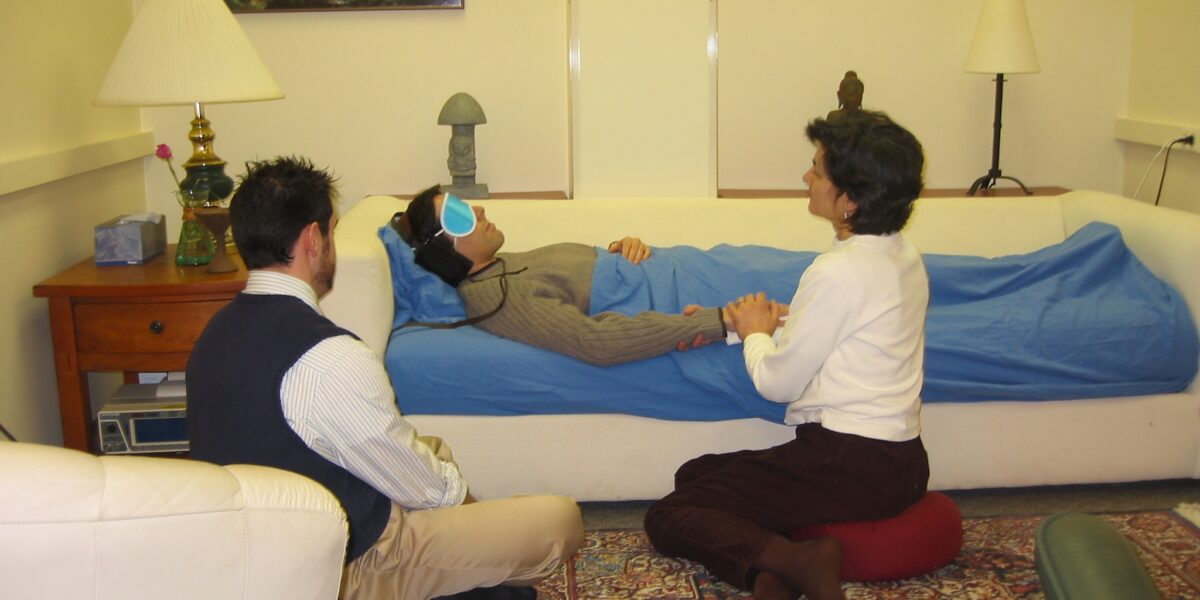
British MP Christopher Mayhew took mescaline in 1955, under the supervision of psychiatrist Humphry Osmond (who gave mescaline to Aldous Huxley). He had his experience filmed for a BBC Panorama show, although it was never broadcast. Under the influence of 400 mg of mescaline (the same dose Huxley took), Mayhew described strong time distortion effects. He said to Osmond during the experience:
I assure you that from my point of view, from the time I begin this sentence and the time I end it, I shall be gone…a long time Humphry. I am moving from one time into another time, and back again. There is no absolute time, no absolute space, there is simply what we impose on the outside world.
Reflecting on the experience 30 years later, Mayhew said:
About half a dozen times during the experiment, I would be withdrawn from the surroundings and myself and have an experience, a state of euphoria, for a period of time that didn’t end for me – it didn’t last for minutes or hours, but for months.
The psychiatrists afterwards and common sense all say that’s nonsense, you couldn’t have these experiences because there was no time. I accept that. At the same time, they didn’t have the experience. And when I look back even now, after 30 years, I remember that afternoon not as so many minutes spent in my drawing room, but as years and years of heavenly bliss…I think the simplest explanation is that I had these experiences, they were real, but they took place out of time.
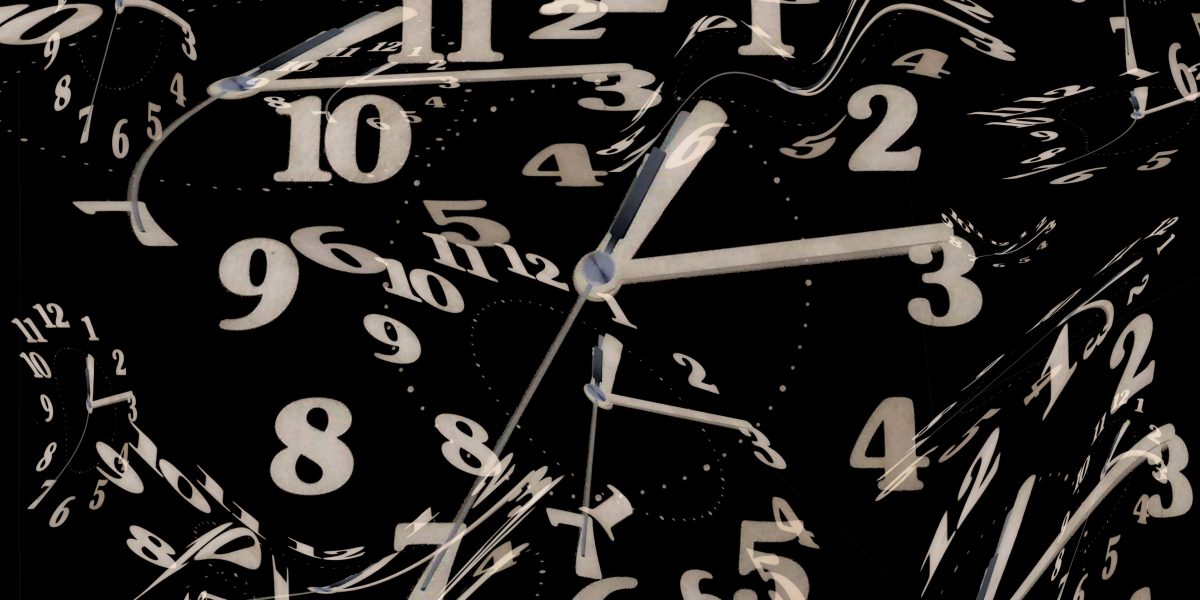
It is common, under the influence of a psychedelic, to feel that the experience is lasting much longer than it actually is; minutes can feel like hours, hours can feel like days. One might think, How can that be the time? It’s only been an hour!? The terms ‘trip’ and ‘journey’ are apt, in light of these time-dilating effects. Time dilation is perhaps the more common type of time distortion effect. However, time-constricting effects can occur, too, in which the passing of an hour feels extremely short-lived.
On the more mystical side of the experiential spectrum, it can feel like one has the experience outside of time, or time becomes a meaningless concept. (The loss of the sense of time and space, or the experience of timelessness and spacelessness, is one of the core characteristics of the classic mystical experience.) One may have the sense of existing in eternity, or an ‘eternal now’. This is the kind of experience that Huxley was hoping to experience. It was one of the main reasons he wanted to try psychedelics. His mother died when he was 14, which brought into focus for him the suffering caused by duration and the finitude of life. As he wrote in Brave New World Revisited (1958), “The most intractable of our experiences is the experience of Time – the intuition of duration, combined with the thought of perpetual perishing.”
Huxley hoped to escape time consciousness through mysticism, of the kind explored in his novel Time Must Have a Stop (1944) and his book on mysticism, The Perennial Philosophy (1945). As he wrote in the latter work,” Immortality is participation in the eternal now of the divine Ground.” He also practised Vedantic meditation in California in the 40s, intending to escape the suffering brought on by time consciousness. He didn’t have much luck through meditation, but he did through his mescaline experience; psychedelics, he discovered, could chemically catalyse the experience of eternity or timelessness. As he opined in The Doors of Perception (1954):
To be shaken out of the ruts of ordinary perception, to be shown for a few timeless hours the outer and inner world, not as they appear to an animal obsessed with survival or to a human being obsessed with words and notions, but as they are apprehended directly and unconditionally by Mind at Large – this is an experience of inestimable value to everyone and especially to the intellectual.
In an article for Vice on the time-distorting effects of psychedelics, the journalist Shayla Love describes some of the early research on these effects:
A review from 1964 on hallucinogens reveals how long we’ve been playing with the dials of time—speeding it up, and slowing it down—through drugs. One account from 1913 on mescaline intoxication said that mescaline made a person feel like “the immediate future was rushing on at chaotic speed, and the time was boundless.”
A study from 1954 found time disorders in 13 out of 23 people under the influence of psychedelics. Most of them felt a “sense of temporal insularity,” where only the present was real and the past and future were far, far away. “One subject experienced a ‘timeless, suspended state; a few felt time to be slipping away very quickly, whilst in others the passage of time was slowed down,” the review wrote. “In one case where the mood fluctuated between elation and depression, the passage of time was experienced concurrently as rapid and slow.”
Psychedelics are believed to affect time perception through their activity at serotonin 5-HT2A receptors (activity at this receptor is also associated with time distortion in psychiatric disorders like schizophrenia). In terms of the brain regions involved, one paper notes:
Psilocybin-driven FC [functional connectivity] changes were strongest in the default mode network, which is connected to the anterior hippocampus and is thought to create our sense of space, time and self. Individual differences in FC changes were strongly linked to the subjective psychedelic experience.











































share your toughts
Join the Conversation.
Excellente analyse.