Welcome to
Chemical Collective

Are you 18 or older?

Please confirm that your are 18 years of age or older.

You are not allowed to access the page.

info-icon €100 for domestic (NL, CZ, DE) €125 for the rest of the EU, excluding stealth shipping

Free shipping over €50 & free tracked shipping over €100

Friendly customer service available 9-5pm Monday to Friday

Free shipping over €50 & free tracked shipping over €100

Friendly customer service available 9-5pm Monday to Friday

Your cart is empty

The Machinery of the Mind: Henri Michaux’s Mescaline Experiments

david-blackbourn

By David Blackbourn

19467339355 8f094ac82c o
in this article
  • Miserable Miracle
  • The Mescaline Drawings
  • Michaux vs Huxley
  • A Necessary Counterpoint
david-blackbourn

By David Blackbourn

Disclaimer: The views and opinions expressed in this article are those of the authors and do not necessarily reflect the official policy or position of Chemical Collective or any associated parties.

Through an error of calculation, I swallowed six times what is for me a sufficient dose. I was not aware of it at once. Eyes closed, I watched in myself, as on a screen or a ship’s log, the colors and the lines, this time gigantic, of Mescaline appearing in my inner vision, and the agitation of the images, always so amazing. Then suddenly, nothing any longer. I saw nothing. I had slipped down to some bottom. A door, open till now, had suddenly closed in absolute silence.

– Henri Michaux, Miserable Miracle

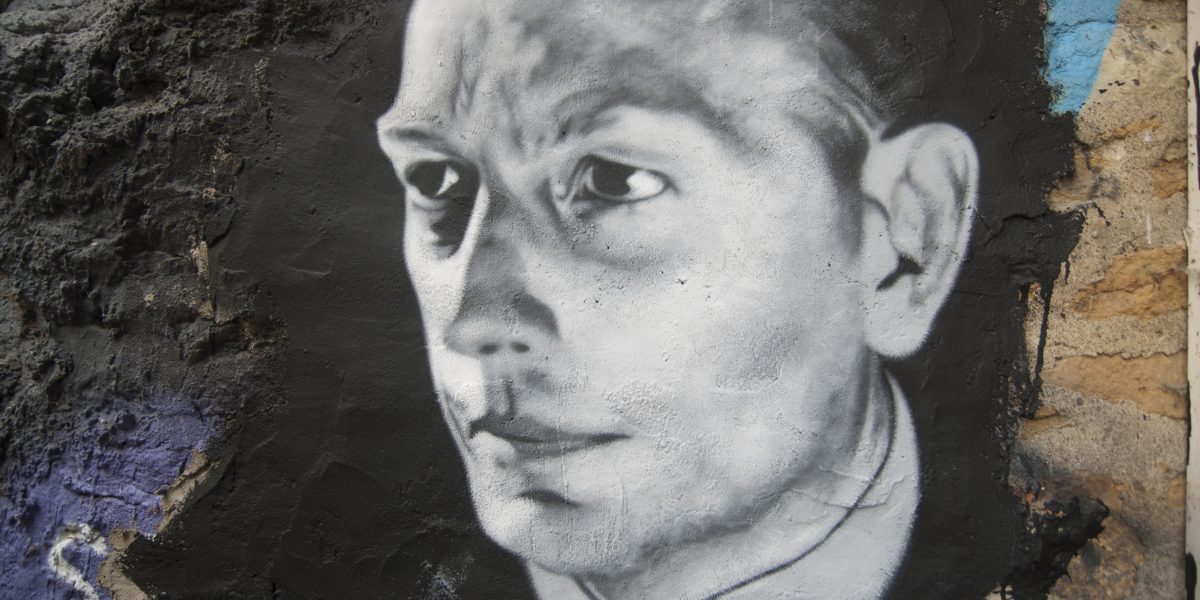
The experimental poet, writer, painter and lesser-known psychedelic explorer Henri Michaux sits quite at odds with the archetypical image of the mid-20th-century psychonaut. We might think of Aldous Huxley flinging wide in The Doors of Perception, fascinated by the divine and the “labyrinth of endlessly significant complexity” in his flannel trousers, for example. Or, Timothy Leary proselytising for us to “turn on, tune in, drop out”. For figures such as these, the psychedelic realm was seen as a promised land, a source of spiritual and societal liberation. Michaux stands out as profoundly different. Far from an active seeker of utopia or in search of messianic visions, he explored psychedelics as a reluctant, sober, and deeply sceptical investigator.

Born in Namur, Belgium, in 1899, Henri Michaux was already a known figure in art and literature prior to his psychedelic encounters. His work explored his own inner landscapes, and he was celebrated for his introspective poetry:

“In the night
In the night
I united with the night
To the limitless night
At night”

– Henri Michaux, Dans La Nuit

And for his pen drawings, which blurred the line between writing and image.

In 1954, as part of an experiment prompted by his publisher, Michaux tried mescaline for the first time, a psychedelic compound derived from the Mexican Peyote cactus. Though he was already 55 years old and a firmly established pillar of the artistic community, the experience transformed his life and future work. Over the next decade, the otherwise habitually sober Michaux wrote several books on his psychedelic experiences, which included dozens of vivid drawings.

Michaux was an artist who was, from an early age, interested in the relationship between drawing and writing – a master of the use of both line and language to transmit ideas. Mescaline would expose him to a state which could annihilate both of these abilities entirely. In his own words, translated in The Paris Review:

What immediately interested me…was the rapport between the image and the idea, between the wish to see something and what one sees. In mescaline one finds an independent consciousness…its own world of images. One learns what it is both to have and not have a will.

Michaux did not simply want to lose himself within the drug; he wanted to remain an observer, to watch himself become lost, to document the process of his own consciousness being systematically dismantled. This paradox at the heart of the experience drove his future work. He was not looking for the beauty in a flower, or God in a grain of sand, or anything of the sort – just the raw, unvarnished truth of the experience. He did not discover a blissful paradise. It was something far stranger and more violent, what he called a “miserable miracle”.

Miserable Miracle

This book is an exploration. By means of words, signs, drawings. Mescaline, the subject explored.

This quote from the foreword of Michaux’s Miserable Miracle, his best-known work, a vivid account of several of his mescaline experiences, perfectly encapsulates the to-the-point tone with which he hoped to explore the subject. In the foreword, he describes the inherent difficulty of this endeavour, though, when the original writings/drawings themselves were created under the influence:

The original text [was] more tangible than legible, drawn rather than written…flung onto and across the paper…interrupted sentences, with syllables, flying off, frayed, petering out. Their tattered remnants would revive, bolt, and burst again. The letters ended in smoke or disappeared…their wings cut in flight by invisible scissors.

In his search for clarity and data, he did not so much uncover, but was more subjected to a series of discoveries that fundamentally challenged the nature of the self, reality and art itself. Suffice it to say, clarity was not easy to come by on mescaline.

His first overwhelming discovery was what he described as “insurmountable difficulties” stemming from the “incredible rapidity of the apparition, transformation, and disappearance of the visions.” The mescaline experience was defined by this seemingly unending velocity. He felt he was “swept headlong without ever turning back [at] unendurable speed.” This was torturous for an artist whose work was defined by careful contemplation. The “intolerable haste” he felt within rendered his usual artistic toolset utterly useless. How could he coherently explain a thought when it was immediately replaced by a thousand others? The unbridled speed, he felt, was not a creative energy, but a destructive force which demonstrated his utter powerlessness.

Flowing directly from this “unendurable speed” was his next realisation – a profound alteration of the self, itself. Psychedelic literature is rich with descriptions of “ego death”, typically seen as a transcendent dissolution into a greater whole. Not so for Henri Michaux. He did not gently dissolve; he was shattered and torn apart. He described a state in which his “calm was violated a thousand times by tongues of infinity,” concluding that “the thousands upon thousands of rustlings were my own thousand shattering.” He felt an initial disconnect within himself, where he was forced to “watch like a stranger” his own seemingly mechanical movements. During the most intense period of the experience, he was no longer even a person in control at all but something “caught, not by anything human, but a frenzied mechanical agitator, a kneeder-crusher-crumbler, treated like metal in a steel mill”.

This was far from a spiritual union; he felt nothing but alienation from himself, the self, split apart against his will. This sets Michaux further apart from his contemporaries. In his attempt to relate his experiences as an observer, free of bias, he discovers an innate inability to do so. Post-war art and philosophy had reflected the idea of the self as free and responsible for its thoughts and actions. As a result of his mescaline experiences, Michaux now saw that this unified “self” was in fact a comforting fiction – a fragile and temporary construct.

Michaux’s third discovery concerned the fundamental nature of reality itself. When the initial onslaught of fractured images subsided, it was replaced by a universe now shorn of all meaning. Michaux watched reality melt away into a world of “unemotional character” and “mechanical appearance.” This was a world of unthinking movement alone, where “enormous plowshares plow without any reason for plowing.” Endless movement without meaning, where he was subject to the “torture of what is unstable…what is impermanent.” Once again, Michaux stands apart from his contemporaries; he did not join figures like Huxley in a divine, spiritual dimension. He was “caught and held prisoner in some workshop of the brain.”

This was the crux of it all. The true “misery” of the miracle. The realisation that beneath the realm of human perception lies this abyss of meaninglessness. Endless, undulating energy. It was this “prodigious vibration, multiple, delicate, polymorphous, appalling,” that he would attempt to draw to create a direct record of the experience, which words could not explain.


The Mescaline Drawings

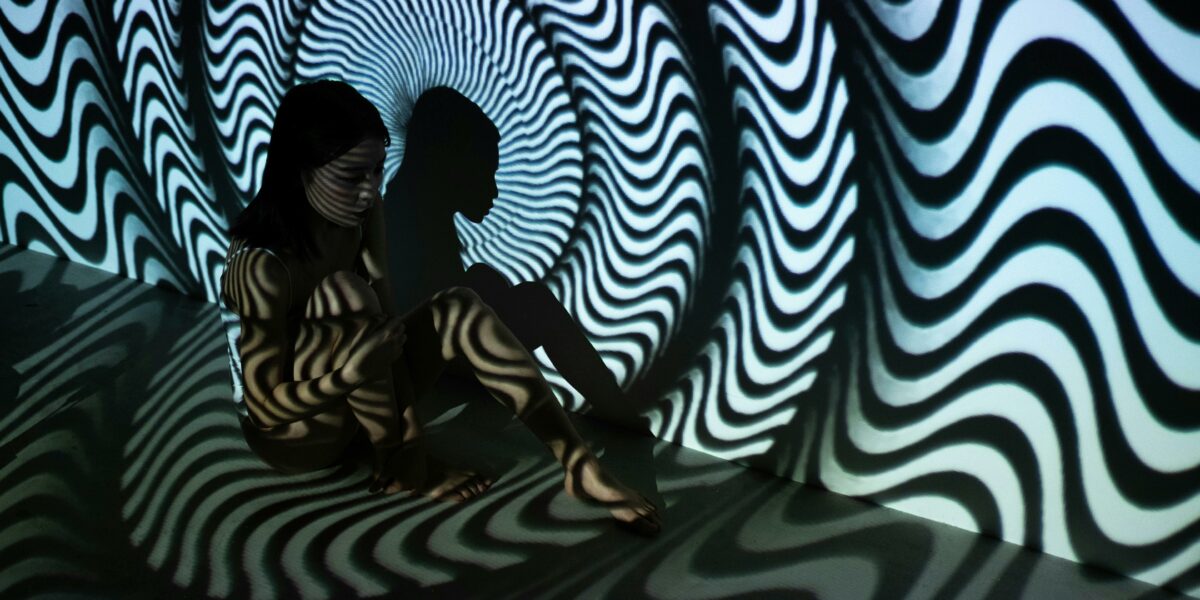
Mescaline faced Michaux with an inner world in which his mastery of the word had ceased to be of use and the sheer velocity of existence had surpassed language entirely. So, in his attempts to honestly relate the experience, he turned to abstract drawings as opposed to words. These are seen as the most direct evidence of his discoveries. Less illustrations of the experience, they are the experience itself, the juddering, gyrating lines, reflecting the nauseating reality. The violent tremors of a nervous system under the influence of a psychedelic.

Again, here, the paradox at the heart of Michaux’s experience. The masterful artist, always focused on control, was now out of control of the movements of his hands. While this destroyed any precision in the delivery of the vast inner landscapes mescaline revealed – in a usual artistic sense – it is in fact that lack of precision itself which reflects the shattered reality of the mescaline experience.

Each mark is less a representation of an experience, more a residue of it, mescaline guiding the pen, while the failing agency of the artist himself fights to maintain control. This struggle is visible in the art, the frantic, agitated lines, and the obsessive repetition of motion. We can literally see a fully conscious mind attempting desperately to document a state which was simultaneously overwhelming his motor functions. There are no recognisable figures or objects; instead, the drawings consist of “very fine parallel lines, very close together with an axis of symmetry and endless repetitions.”
Ultimately, Michaux attempted to use the pen as an instrument of transcription in much the same way as he documented the experiences with words. A new form of documentation, bypassing metaphor entirely to create a record that “directly and simultaneously translated the subject, the rhythms, the forms, the chaos, as well as the inner defenses and their devastation.” He knew that a perfect translation was, by its very nature, impossible. But in the heroic attempt at a direct record under the onslaught of mescaline, he succeeded in creating an intense visual record of the “miserable miracle” he experienced, or rather, he was forced to experience.

You can see all of the collected Mescaline Drawings HERE.


Michaux vs Huxley

To fully grasp the originality of Henri Michaux’s findings, we can place them beside those of his far more widely known contemporary, Aldous Huxley. The two both used mescaline at roughly the same moment, Huxley in 1953, Michaux in 1954, and yet they returned from their respective journeys with almost polar opposite accounts. This chasm between their reporting is possibly the single most important lesson about psychedelics that we can take from this. It reveals plainly the fact that psychedelics do not open a door to another place; there is no fixed destination. Psychedelics are a mirror reflecting the inner world of the individual.

Huxley’s mescaline experience, outlined in The Doors of Perception, described a kind of mystical union and transcendent beauty. Huxley theorised that the brain and nervous system function primarily as a filter “to protect us from being overwhelmed and confused by this mass of largely useless and irrelevant knowledge.” For him, mescaline acted as a chemical key to unlock the full potential of the mind, what he termed the “Mind at Large.” He was thrust into a world of heightened beauty, perceiving the divine in the mundane. A simple bunch of flowers became “what Adam had seen on the morning of his creation…the miracle, moment by moment, of naked existence.” Everything was revealed as it was, shorn of all symbols. For Huxley, this was a “sacramental vision of reality” where everything shone with an “inner light.” This was an experience of profound meaning. Homecoming.

For Michaux, it was an exile. Where Huxley found unity, Michaux felt only fragmentation. Where Huxley gleaned divine meaning, Michaux experienced wild, mindless, mechanical motion. The “Mind at Large” Huxley described, the calm, all-encompassing consciousness was, for Michaux, nothing but a hurricane of images, a never-ending swarm of meaningless activity. His mind was not cleansed; it was at war! He found no evidence of a higher intelligence or any kind of cosmic plan. Instead, the drug revealed that any sense of “plan” at all, even on an individual level, was nothing more than a comforting illusion. What emerged was a colder world of pure, indifferent energy, and a self that was merely a temporary bundle of disconnected processes. For Michaux, the true foundation of reality was chaos.

A Necessary Counterpoint

Michaux never said he was a guide or that his work provided any kind of path to transcendence. Quite the opposite. Over a decade of methodical exploration, he produced one of the most complex, detailed bodies of work on the subject of psychedelics. His work stands as a visceral, honest reconstruction of a mind under the influence. Miserable Miracle, in particular, is a classic of global drug culture, which to this day seems somewhat neglected.

Michaux’s work is an excellent counterpoint to the more familiar narratives throughout psychedelic culture. While Huxley’s Doors of Perception is rightly praised as a foundational text in the psychedelic canon, Michaux’s work is “more extensive [and] complex.” Where Huxley found abstract, philosophical absolutes, Michaux directly engaged with the raw deconstruction of his mind. The relative obscurity of his work can perhaps be attributed to its sheer complexity – and it is certainly wordy – but I think this is what makes it so interesting. These aren’t simple trip reports; they are a deep investigation into consciousness itself and the terrifying complexity of the mind unmoored from narrative coherence.

Michaux’s legacy is not just one of a witness then, but of a pioneer whose work deserves more widespread recognition. His genius lies not in his willingness to swallow a chemical and simply relay its effects, but in his refusal to simplify the profound mystery that its effects revealed. Through both words and line drawings, he was able to relate the totality of the experience with a weirdly deliberate-accidental precision, allowing his pen to chart a course through the sickening vibrations of mechanical chaos, to the ecstatic, violent unity of the abyss. Where others open a door to the mystical, Michaux holds up a mirror to the often frightening machinery of the mind, showing that, without artifice, any exploration of consciousness cannot help but reckon with the darkness and the light. The misery, and the miracle.

David Blackbourn | Community Blogger at Chemical Collective

David is one of our community bloggers here at Chemical Collective. If you’re interested in joining our blogging team and getting paid to write about subjects you’re passionate about, please reach out to Sam via email at samwoolfe@gmail.com

share your toughts

Join the Conversation.

0 Comments
Inline Feedbacks
View all comments

Related articles

Our Products

Related Products

1V-LSD 150mcg Blotters
1V-LSD 150mcg Blotters From 22.00
(143)
1cP-LSD 100mcg Blotters
1cP-LSD 100mcg Blotters From 18.00
(137)
Tryptamine Mix and Match Pack (4 x 0.1g)
Tryptamine Mix and Match Pack (4 x 0.1g) 65.00
(1)
1V-LSD 10mcg Micro Pellets
1V-LSD 10mcg Micro Pellets From 15.00
(43)
2-FDCK HCL
2-FDCK HCL From 12.00
(82)
1V-LSD 225mcg Art Design Blotters
1V-LSD 225mcg Art Design Blotters From 35.00
(62)
1S-LSD 150mcg Blotters
1S-LSD 150mcg Blotters From 29.00
(16)
1cP-LSD 150mcg Art Design Blotters
1cP-LSD 150mcg Art Design Blotters From 25.00
(74)
1V-LSD 225mcg Pellets
1V-LSD 225mcg Pellets From 35.00
(26)
1D-LSD 225mcg Pellets (1T-LSD)

SALE! -15%

1D-LSD 225mcg Pellets (1T-LSD) From Original price was: €42.00.Current price is: €35.70.
(13)
1cP-LSD 10mcg Micro Pellets
1cP-LSD 10mcg Micro Pellets From 15.00
(23)
5-MeO-DMT Freebase
5-MeO-DMT Freebase From 23.95
(36)
O-PCE HCL
O-PCE HCL From 17.50
(25)
1cP-LSD 20mcg Micro Blotters
1cP-LSD 20mcg Micro Blotters From 18.00
(27)
4-HO-MET Fumarate
4-HO-MET Fumarate From 19.50
(26)
rewards-icon
popup-logo

Reward program

popup-close
  • Earn
  • Affiliates