in this article
- Worlds Apart
- The Paradoxes of Surrendering
- Gaining Control
- Cultivating Skill
Are you 18 or older?
Please confirm that your are 18 years of age or older.
You are not allowed to access the page.
Disclaimer: The views and opinions expressed in this article are those of the authors and do not necessarily reflect the official policy or position of Chemical Collective or any associated parties.
Control is one of the most fascinating and perplexing issues around psychedelics. Drug use almost goes hand in hand with loss of control. Sometimes it is the main purpose for doing it, like drinking alcohol at a social gathering to loosen up and relax some inhibitions. With psychedelics, we often have contradictory expectations. We want to be surprised, discover new things, and even get transformed, yet keep some control in this process, understand how it happens, and reach certain goals. It turns out that the relationship to control differs greatly between Western, East Asian, and indigenous traditions. A dive into some of these practices can help us understand and tackle this issue.
Our general conceptions of freedom and control are somewhat arbitrary. In liberal countries like the Netherlands, citizens are not free to build a house, homeschool a child, put up a tent, throw a party, demonstrate, place a recycling machine, you name it – without permission from the state. We are so afraid of our own conduct that “we have to make laws to regulate our behaviour, employ police to keep ourselves in order, and equip armies with explosives to prevent us from blowing ourselves up”, as Alan Watts beautifully puts it in Become What You Are. Still, we consider ourselves free citizens. At work, we need permission to take a day off, we have to arrive and leave at specific times, and sit in the office even if the work can be done elsewhere. We invent locks and thieves’ tools, viruses and anti-viruses, in an endless game that gives us a sense of control. All of this seems normal, even appropriate, because we are not used to accepting the limits of our control, and even less so to facing the unknown calmly.
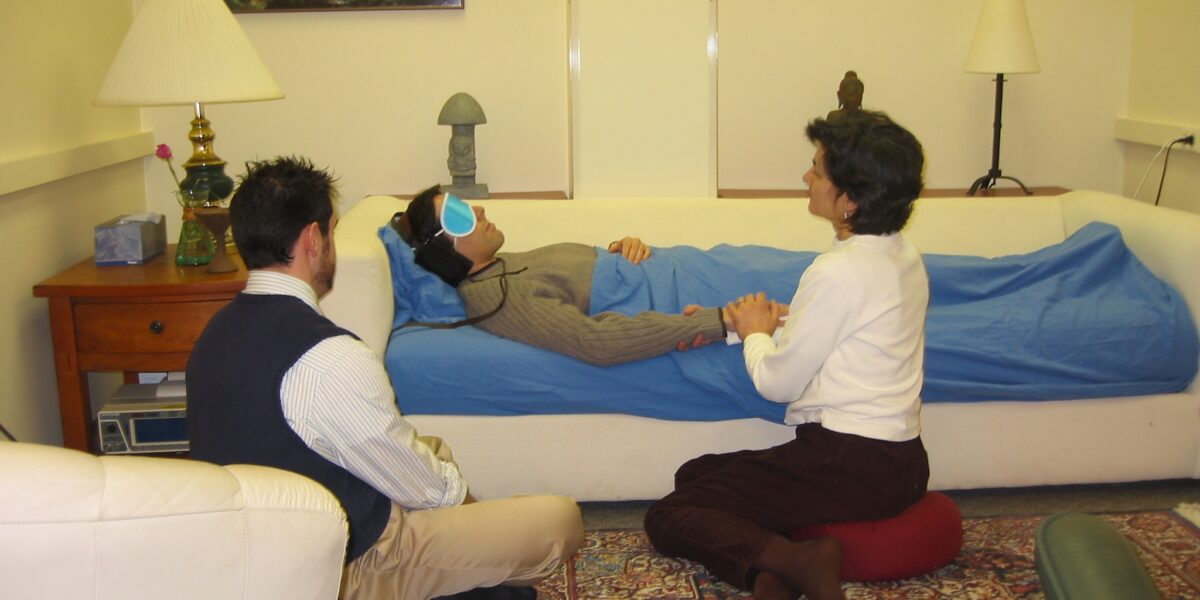
This state of constant anxiety and grasping is the inspiration behind the Johns Hopkins advice to “trust, let go, and be open to the experience”, which by now has become a famous slogan and suggested mantra in psychedelic therapy, especially with high doses. It has roots in spiritual practices, and is often phrased in similar ways in meditation and mindfulness, psychedelic retreat centres, and some ayahuasca ceremonies. So, what are we to let go of? Psychedelic researcher Robin Carhart-Harris explains that we need to let go of “emotional and mental connections and anticipations while sustaining a receptive attitude toward innovative occurrences and perceptions.” In other words, it is better not to have any expectations, neither about the experience nor about its results. Staying open to novelty means that the things that will come up will not necessarily fit into our categories. So we need to be able to let go of those concepts and images through which we see the world and describe ourselves. After all, being open to change means being ready to let go of who you were.
Interestingly, this is almost the opposite of indigenous shamanic practice. As Nicolas Langlitz and Alex K. Gearin explain in their paper ‘Psychedelic Therapy as Form of Life’, published in Neuroethics, the psychedelic experience is a much more active and disciplined process where shamanic healing is concerned. Amazonian healers “cultivate ‘rigorous emotional control’ and resist ‘losing one’s mind’ during psychedelic experiences. Simply trusting and surrendering to frightening experiences—and thus forfeiting volition and autonomy—risks opening the Amazonian patient or healer to psychospiritual harm. They cannot simply ‘trust the process,’ as many psychedelic therapists advise.” Instead, during ceremonies, shamans “whistle, sing, and perform to gain control and steer their own experience and their patients’ experience into the right direction.” How can we make sense of this huge gap?
One thing to consider is that these recommendations are based on different worldviews. We have different assumptions about the world and the things in it, including ourselves. These differences also influence how we see the psychedelic experience. Is it about your Self? Is it communication with other forces? Does it expose your own mind? Mind-at-Large? Non-human beings? Is there magic involved? Witchcraft? Is it all produced by your brain? How dangerous is it, actually?
Langlitz and Gearin explain that “shamans assume that the ingestion of hallucinogens poses serious threats as they bring the user into contact with powerful beings, so only psychologically healthy and stable people should cross over into the chaotic and sometimes violent visionary world.” As we can see, the contrasting worldviews lead not only to different advice, but also to different assumptions about who can or should take psychedelics. Langlitz and Gearin stress that “even trained shamans are taking a risk: some break, lose self-control, and become sorcerers who foster discord rather than harmony between people.” Thus, with a worldview of contrasting forces, benevolent and malicious, creative and destructive, surrendering to whatever comes might be perilous. The same goes for the idea of “trust”, as an unfamiliar Amazonian shaman may be a healer but also a sorcerer.
In the Western view, psychedelics pose very little risk to one’s physical health, yet a trip can still be an unpleasant experience and cause long-lasting difficulties. In The Psychedelic Experience: A Manual Based on the Tibetan Book of the Dead (1964), authors Timothy Leary, Ralph Metzner, and Richard Alpert (later Ram Dass) discuss the idea of “surrendering” as a technique for self-liberation, based on Eastern philosophies, mainly Buddhism, in conjunction with Western psychology. It is based on the premise that “whether you experience heaven or hell, remember that it is your mind which creates them.”
Still, exposure to unconscious material can include threatening or overwhelming content, like past traumas, exposure of parts of yourself you were not aware of, unflattering reflections of society’s or your own values and behaviour, and new understandings about the nature of reality. If it comes prematurely or in an unsafe environment, it can be retraumatizing or result in an ontological shock. Even when the content is ‘positive’ and meaningful, it may call for a long period of processing, so one has to be ready to face whatever comes, not only during the trip, but also during the aftermath. Teachings may have consequences for relationships, professions, living conditions, jobs, and beliefs. For example, some institutions may lose their meaning for you, but out there, they still exist and exert their authority. Other people, including those you love, may still believe in them. Such entanglements can confuse and amount to despair, nihilism, and even existential crisis.
Letting go or surrendering implies passivity in the sense that, rather than taking an action, it is refraining from exerting control and striving, so there is an inherent paradox in trying to surrender actively. According to Alan Watts, we find a similar contradiction in the notion of self-acceptance. Our attempts to reject or accept ourselves are futile, because “they fail to reach that inaccessible centre of our selfhood which is trying to do the accepting.” In the same way, the you who is actively surrendering is still in control. When psychedelics are taken as medicines for treating symptoms of mental disorders, more paradoxes appear. How can one take psychedelics to alleviate their depression symptoms and let go of their expectations (to alleviate their depression symptoms) at the same time?
Another common expectation of “surrendering” is to reach the longed-for mystical experience or ego-dissolution, whether for its psychological or spiritual benefits. Marketed as TLO, “trust, let go, and be open” is supposed to be the best method to avoid harm and reach a mystical state, which in turn, statistically delivers the highest chance for long-term change. Can you count the number of anticipations here? The psychedelic researcher Robin Carhart-Harris explains that TLO serves “as a navigational aid for efficiently managing the diverse sensations and perceptions that arise during psychedelic experiences.” So it seems like the goal of letting go is to be able to manage, to control.
Paradoxes aside, it is true that resistance does not get you anywhere, psychedelics or otherwise. That’s why Bill Richards, a long-time clinical psychologist working for Johns Hopkins, encourages people “to look the threatening image in the eye” if anything scary comes along. Trying to avoid it usually makes things worse, as people tend to become paranoid and confused. The moment of giving up is when the experience usually takes a more positive tone. This is an important aspect of surrendering: meaningfully accepting that you cannot fully control the experience (or life in general), and that you need to deal with whatever comes. So perhaps rather than giving up control, it is giving up the false sense of having it.
An article by Gary Fisher published in The Psychedelic Reader details some of the 1960s experiment protocols and reveals how “surrender” was approached. As preparation, subjects inhaled a mixture of 30% CO2 and 70% oxygen before the LSD session. The session itself often started with sedatives so that patients could relax, followed by 100-200 micrograms of LSD plus 200-400 milligrams of mescaline. Sometimes other drugs were involved, especially with patients who were still anxious. At the time, the standard dose for an initial psychedelic experience was considered between 300-500 micrograms, which we would today call an advanced to heroic dose. Fisher explains that “it is best to use the most potent material available to increase the probability that an individual will be able to overcome his resistance and attain a state of cosmic (expanded) awareness.” In other words, the given dose(s) had to be high enough to force you to surrender.
Russ et al. found that states of surrender or preoccupation at the time of ingestion predicted optimal and mystical experiences and adverse experiences respectively. So safety may lie in your state of mind and feelings before actually embarking on the journey. A little bit of fear or nervousness before taking a psychedelic, or any drug, actually, is a healthy reaction, but extreme fear, panic, confusion, and resistance can result in challenging and retraumatizing experiences. Another important feature is to let go of the mind’s attempts to make sense of the experience as it happens. Richards encourages patients “to send their intellects outside to play in the yard during the period of drug action, rather than trying to cognitively categorise the experience when it is occurring.”
Rebeka Senanayake came to the Amazon as a researcher with a background in anthropology and psychology. She spent ten years there doing field research as well as following a shaman’s apprenticeship. Her reflections attest to the tensions between worldviews and their consequences for the psychedelic experience. She tells about that moment when “a maestro told me to stop just observing my visions and start developing a relationship with the plant.” She did not know relationships with plants were possible.
Robin Rodd, who studied Piaroa shamanic practice, explains that “yopo and capi are conceived of as entry points into a world of potentially infinite knowledge and power”. Instead of receiving such information passively, i.e. observing visions, shamans “must cultivate the skills required to interpret data that yopo visions can make available.” To acquire this skill, indigenous shamans go through long periods of apprenticeship with a teacher and a whole body of mythology and cosmology to help them navigate and interpret experiences and control their mind. Roger Walsh, a professor of psychiatry, philosophy, and anthropology, describes it as follows: “this is a period in which the mind is trained, the body toughened, cravings are reduced, fears faced, and strengths, such as endurance and concentration, are cultivated. This is usually a slow and lengthy process where success may be measured in months and years, and patience is not only a virtue but a necessity.” Indeed, Senanayake’s maestro said that “learning the plants requires dominating them – meaning that instead of letting the plant control you, you need to learn how to guide the plant. In order to achieve this he said he needs a minimum of five months.“
In the West, we have neither time nor patience for long processes. We would rather buy fast food than cook, fly to India for a month of Vipassana rather than meditate daily, and take one huge dose of psychedelics to save on years of therapy. Perhaps it is this obsession with efficiency and fast results that led us to adopt a kind of shock therapy instead of investing in training. Yet the shortcut could very well be what makes the practice so risky.
Putting aside competing cosmologies, I think time, practice, and experience can bridge some of the gaps between these approaches. In many disciplines of asceticism, achieving liberation goes through a process which includes hardships like dietary restrictions, facing the cold, and solitude. For example, spending time in solitude is part of spiritual development in traditions as far apart as Tibetan monks, the Inuit, and Christians. Walsh explains that the reason for this practice is “to allow attention to be redirected inward away from the distractions of the world”. It teaches concentration, quiets the mind and increases sensitivity to one’s inner world. “Those who face themselves in solitude soon come to appreciate just how restless and out of control the untrained mind is”, he explains. According to this approach, being out of control is our basic state, and staying calm and safe calls for training of the mind.
The anthropologist Tim Ingold defines knowledge as skill rather than information. Seen like this, the growth of human knowledge and wisdom through the generations lies not in passing on specific information (i.e. worldviews) but in the “education of attention”. If this is our focus, indigenous shamans, Tibetan monks, meditators, cold plungers, and psychonauts are not so far from each other. Whether it’s with plants, other people, yourself, a molecule, or elements in the environment, trust and relationships take time to cultivate.
In an interview with Paul F. Austin for The Psychedelic Podcast, Ryan Duey discusses some similarities between psychedelics and cold exposure. Cold exposure is a technique of, well, deliberately exposing the body to cold temperature for a short time, to gain physical and psychological benefits. The safest and most sustainable approach is to “start low and go slow”. Duey says that cold exposure “is like a gym for your nervous system”: by exercising it consistently and gradually, you learn to let go. Rather than fighting the cold, you learn to use your breath and give in to the cold. So, if we go back to relationship and trust – this time with the cold yourself – you learn to hand control over to a non-cognitive part of yourself. Alan Watts calls that part “the you that grows your nervous system, rather than the you that uses the nerves to decide, think and act.”
The neuroscientist Andrew Huberman explains that in order to be able to trust and let go, you need to be in a safe environment, which corresponds to having a good set and setting. As ‘cold’ is a personal thing, you need to find that sweet point where it’s cold and scary, but you’re still able to stay inside the water – and leave at your own choice. Like with large doses, starting too cold might earn you a cold shock, so it’s better to start easy and move to lower temperatures as you practice and get more comfortable. According to Huberman, “it is a skill that carries over to situations outside of the deliberate cold environment, allowing you to cope better and maintain a calm, clear mind when confronted with real-world stressors.” So by training from a position of autonomy and self-control, we can accept what arrives without going mad, and remain cool (pun intended) in the face of adversity.
In the psychedelic case, there can always be surprises, which explains why even trained shamans risk losing their minds. So, while practice does not make perfect, can we approach them in a safe manner? With most psychedelics, if you did not take too much (which is a personal thing), there are ways to dive more into or away from the experience. For example, sitting still and concentrating, eyes closed or staring at some point, you can go deeper and deeper. If you feel too uncomfortable for any reason, opening your eyes or looking away may suffice to get you out of there. When you feel ready, you can start concentrating again in order to dive back into the experience and maybe stay a bit longer.
For sure, this sort of training already demands a certain amount of skill, like controlling your attention to a level that permits shifting between these states, and trusting yourself that you can navigate them safely. Training and harm reduction begin long before ingesting anything. Many factors should be taken into consideration, so it’s best to begin by asking some questions. Am I in a safe environment? How much do I want to take, and why? Am I ready for this today? All of these questions are context-dependent, so they should produce different answers based on different days, places, seasons and other circumstances. Reflecting on what happens after the trip is also important. Am I physically and mentally available to interpret and integrate a meaningful or challenging trip? Do I have any experience? Am I mature enough? Do I have enough training and skill? If you are not entirely sure, why not start low and go slow?
Annabelle Abraham | Community Blogger at Chemical Collective
Annabelle is one of our community bloggers here at Chemical Collective. If you’re interested in joining our blogging team and getting paid to write about subjects you’re passionate about, please reach out to Sam via email at samwoolfe@gmail.com
Welcome to Chemical Collective.
Create an account to earn 200 welcome points.
Already have an account? Sign in
Check out our Community Blog and get involved with the conversation. You will be awarded 50 x ChemCoins for each comment up to a limit of 250 total ChemCoins.
Have you purchased any of our products? Reviews and reports are so important to the community. Share your honest opinion, and we’ll reward you with 50 ChemCoins for each review!
Every time you complete an order with us, you’ll be awarded ChemCoins for each Euro spent.
Welcome to Chemical Collective.
Create an account to earn 200 welcome points.
Already have an account? Sign in
Earn commission every time someone makes a purchase through your link.
When you become an affiliate, you will be allocated a unique link to share with your friends, followers, subscribers, or Aunt Susan.
You can choose to payout the commission earned once per month, or save it up to receive on a rainy day! Commission earned is 5% of the total order value per referral.
Contact us to join the Chemical Collective family and become an affiliate.
share your toughts
Join the Conversation.
I feel this essay was well explained. Thank you for the open minded dive into some of the different cultural & possible expectations, experiences and explanations.