Welcome to
Chemical Collective

Are you 18 or older?

Please confirm that your are 18 years of age or older.

You are not allowed to access the page.

info-icon €100 for domestic (NL, CZ, DE) €125 for the rest of the EU, excluding stealth shipping

Free shipping over €50 & free tracked shipping over €100

Friendly customer service available 9-5pm Monday to Friday

Free shipping over €50 & free tracked shipping over €100

Friendly customer service available 9-5pm Monday to Friday

Your cart is empty

The Role of Community in Healing from a Psychedelic Crisis

oli-genn-bash

By Oli Genn-Bash

shutterstock 2533198427
in this article
  • Psychedelic Crisis and the Myth of Individual Healing
  • What Does a Psychedelic Crisis Look and Feel Like?
  • Community as a Container: Models and Movements
  • Moving Towards a Culture of Care
oli-genn-bash

By Oli Genn-Bash

Disclaimer: The views and opinions expressed in this article are those of the authors and do not necessarily reflect the official policy or position of the Chemical Collective or any associated parties.

What happens when our experiences overwhelm us? In these instances, people often refer to what they’re going through as a ‘crisis’, which can feel even more apparent when we have a psychedelic experience. Challenges might be presented to us that are outside of just the acute experience itself, and this might lead to things like confusion, dearealisation, or what some might refer to as ‘spiritual psychosis’ or sensations of feeling overwhelmed. 

But what do we mean when we say to people that we’re going through a crisis? The term is derived from the Greek word ‘krino’, which means either to separate, judge, or decide. The related word ‘krisis’ signifies the preference of one alternative over another, or a point at which change may come, for better or worse. It could be seen as a parting of ways or a point of uncertainty before events move on, with the root of the word being ‘krei’ from Proto-Indo-European, meaning to ‘sieve’ or ‘discriminate’.

Our experiences of a crisis, particularly in a psychedelic sense, could result in a parting of ways from our ordinary confines of consciousness, where we might go through something of a deep rupture which extends beyond the duration of the psychedelic experience itself. It might be tempting just to conceptualise this as being the effects of a ‘bad trip’, but if those feelings from the trip continue to persist for weeks, months, or even years after that experience, we might consider this to be a crisis. 

While there is a growing narrative that overwhelmingly focuses on the benefits of psychedelics, it’s important to note that individuals might find themselves stuck in a post-psychedelic struggle where they experience issues related to mood or fatigue. My own personal experience of smoking 50x salvia extract when I was 19 left me feeling totally empty and confused for a few weeks afterwards, and I still think it’s something I haven’t quite yet fully integrated. The fear and confusion I experienced created a long-lasting sense of feeling totally untethered from my usual reality, and it made me realise how important and useful consensus reality is. 

So what happens when these kinds of experiences are too much for one person to hold on their own? I’m glad that the aftermath of my salvia experience didn’t result in any severe psychological issues, but it certainly infused the energy of subsequent trips with different substances. There was a certain flavour of unease or discomfort, with a worry about the frailty of my mind when I would be exploring further out. It might be why I am so hesitant surrounding big doses of psychedelics, and possibly why I haven’t gone down the route of DMT or ayahuasca, as I fear there might be some retraumatising effects which could bring me back into the salvia experience. 

Thinking about integrating these kinds of experiences from an individual perspective might result in limited effects, as it could be that we need to focus more on relationships and community, rather than just how our experience made us feel. Through the connection with others, we can work our way through these challenging experiences, where our vulnerability can be met with humanity and compassion.

Psychedelic Crisis and the Myth of Individual Healing

I recently had a conversation with psychotherapist and psychedelic integration specialist, Liz Lilley, who mentioned that without the relationships in community, it can be difficult to heal the relationship with ourselves:

If we’re going in alone, where do the experiences go? Even if they’re good experiences, some of those energies aren’t necessarily ours. If you don’t bring it back to the community and have a container for integration, then you can feel more division.

I reflected on this within the context of my own experiences – particularly the one with salvia, where one of the challenging aspects after the experience was not feeling like I could talk about it with any of my family. I remember being at my aunt’s 60th birthday party soon after the experience, which was a big event with lots of people, and I found myself being overwhelmed, where I wasn’t able to really engage with anyone. It’s like I had nothing to say because ‘I’ had been reduced so much, and there was no container or cultural context for this energy. Even the way I consumed the salvia was outside of the usual cultural context (where it’s usually chewed or consumed as a liquid), so there wasn’t necessarily any context in which I could properly integrate how rapidly intense the experience was. 

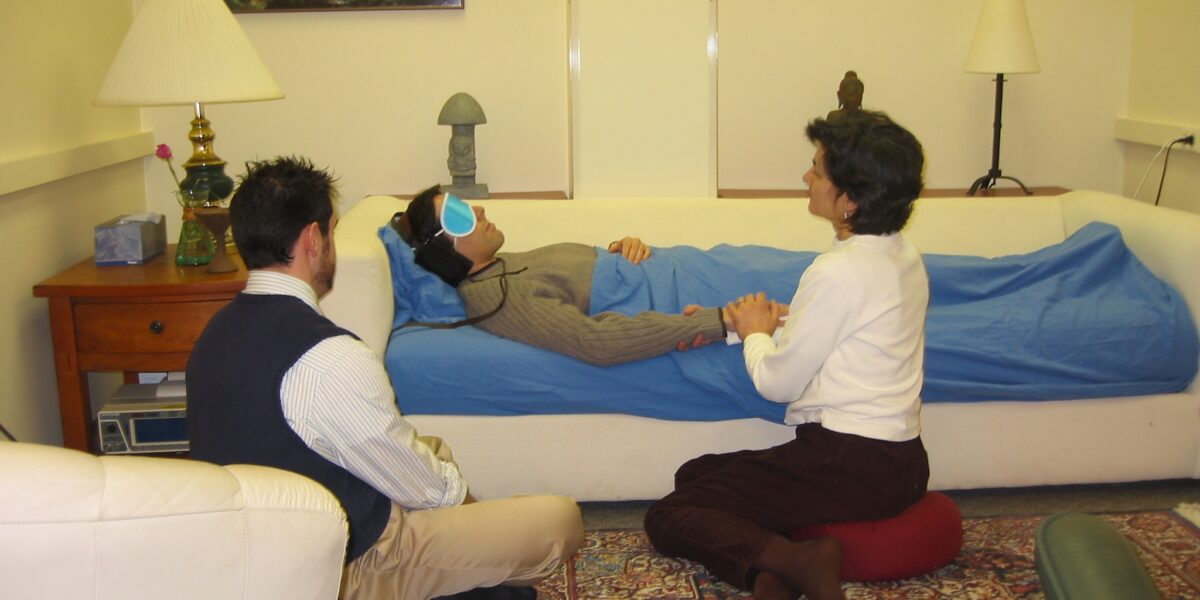
But is this processing simply done on a mental level, where we have to grapple with whatever we’ve experienced on our own? The notable psychiatrist Stan Grof has recommended different activities for assisting with psychedelic integration, such as resting, being in contact with nature, having a long session with a therapist, writing an account of the experience, or engaging in artistic expression, just to name a few examples. It’s hard to argue against these kinds of activities as being helpful for psychedelic integration; however, it does seem like these kinds of activities predominantly involve the individual and how we process our own experiences. 

The modern psychedelic culture seems to have focused more on the effects of these substances in relation to the self, rather than the broader impact of these kinds of experiences in relation to others and our communities. The focus on the individual might actually come at the expense of understanding where the sickness or ‘dis-ease’ presents itself, which could be related more to the communal wellbeing, rather than just existing inside the individual self. 

The 19th century author, Ian Maclaren, once wrote, “Be kind, for everyone you know is fighting a hard battle”, which I think has a lot of merit, as we shouldn’t judge others who are finding life difficult due to past trauma, but I wonder if this sentiment has become too entrenched when it comes to understanding the role of community when we experience something like a psychedelic crisis? Could it be that we actually underestimate how much we can actually resonate with other people’s experiences within the context of community? 

Healing within certain indigenous practices, which might utilise psychedelic plants or fungi, seems to find itself more within a communal framework, where experiences are witnessed by the community, rather than being private to the individual. These kinds of frameworks could potentially provide a more structured container for integration, where there isn’t the kind of ‘ontological shock’ that might be experienced by those in the West who undergo a dramatic shift in their worldview or metaphysical beliefs. 

Going through an experience which shocks us can isolate us even further and potentially exacerbate post-psychedelic stress, especially if one’s worldview has been radically shifted in contrast to others around them. How can we understand the experience of a psychedelic crisis to find ways in which community environments can provide an environment where we feel safe and held?

What Does a Psychedelic Crisis Look and Feel Like?

The concept of having a “bad trip” has become so commonplace that there’s even a Wikipedia page about it. Being described as an “acute adverse psychological reaction to psychedelics”, the idea of having a bad trip was bolstered by anti-psychedelic propaganda in the 1960s, where moral panic and fear surrounding these effects were spoken about more frequently in the media. These decades of anti-drug propaganda have certainly caused a lot of problems, but there might be something to be said for those going through experiences that really push them to the point of crisis. 

These kinds of experiences might mirror what Stan Grof coined as a “spiritual emergency”, where the experience that feels challenging might have contained within it the potential for healing through some kind of spiritual evolution. If these challenges are understood in a way to be a natural part of this process, could the right kind of non-judgmental containers prevent these difficult stages from turning into a psychedelic crisis? 

The welfare and harm reduction organisation PsyCare has defined a psychedelic crisis as being “one’s perception or experiencing of an event or situation as an intolerable difficulty that exceeds the person’s current resources and coping mechanisms.” The symptoms we experience during this crisis might range from general discomfort to difficulty communicating, severe time distortion, thought loops, anxiety and panic attacks, fear and paranoia, aggression, overwhelming feelings and emotions, or grandiose thoughts. 

While writing this article, I had a conversation with my friend, Karin Silenzi De Stagni, who is the founder of Kosmicare UK, which later transformed into PsyCare, and has now established the organisation Psycare International. When speaking about the foundations of these organisations, Karin mentioned that the reason for establishing Kosmicare UK was through personal experience of being aware of the minority of people in the psychedelic party scene who might have been having challenging experiences. There was also the feeling of a need to provide more of a context for these kinds of experiences:

All these substances have a root in culture and there was a necessity to bring sacredness into the situation. There are a lot of chemicals being consumed with no context, and this lack of context can create a state of feeling in crisis. The lack of connection in these states, where people might have traditionally gone with a shaman or a tribe, can also contribute to this crisis

This idea to bring a context of sacredness into the party experience might have been seen as radical, but when speaking to Karin, it was quite clear that community is the most important part of healing. Experienced people are able to provide reassurance, and it’s not necessarily anything more than that. It might be that we’re at an event or festival that doesn’t actually provide the appropriate kind of welfare from an official point of view, and what we need instead is the comfort and support of a tribe or community. The work has to be done as part of a team where everyone is able to bring a different piece of the puzzle to the situation, and provide peer support where the communal aspect can come to the rescue.

This multidisciplinary approach accepts that no one person knows everything, and this allows the community to be embraced, where the team dynamic can provide an even greater chance for someone to move through a psychedelic crisis. These kinds of experiences aren’t occurring in a retreat setting, and it’s important to take greater care and safety when engaging in more recreational psychedelic experiences. The information and support provided by organisations such as Karin’s can effectively give us something like a “seatbelt for a psychoactive adventure” where we’re able to understand what we need to put in place for different kinds of experiences.

Without the right kind of support, we might spiral into feelings of shame or confusion, or a feeling like we haven’t done things in the ‘right way’. Our different life stories might impact how we feel on certain substances, and surprisingly, I’ve witnessed individuals going through difficult experiences with MDMA for the first time where they haven’t actually felt like they’ve deserved to just feel good. It might be that their parents always made them feel like they needed to earn being joyful, rather than just being able to take a substance and simply feel that joy. In one of these moments at a house party, there was a lot of care and attention placed on the individual who felt the need to retreat to their room due to being overwhelmed. We gave a lot of reassurance to them, expressing that it’s OK to feel this new energy and that they were in a safe place with compassionate people. 

This was very much on the milder end of things, and I’ve also witnessed a friend who took too much LSD in an environment where there wasn’t any kind of harm reduction facility, which then resulted in a challenging experience where we attempted to bring them back to base reality over a number of hours. This friend encountered a lot of paranoia and confusion, as well as anger and instances that almost turned physically violent. This kind of experience wasn’t only challenging for the friend going through it, but also for those of us who weren’t necessarily experienced in holding space; however, without there being friends around to manage the situation, I dread to think what could have happened. 

Community as a Container: Models and Movements

In my conversation with Liz Lilley, she mentioned that the conversation surrounding psychedelics has progressed to the point where we can now speak more freely:

Community is formed around the experience, and we can now bring our experience back into the community without feeling ostracised.

This point about not feeling ostracised is hugely important to integrating the experience of a psychedelic crisis, as we are able to feel validated in this discomfort and potentially situate our experience within a wider shared narrative. This feeling of belonging and community is essential to the psychedelic experience, and we might need to focus more on what we can do to build community where we might lack the types of containers in Western culture for these kinds of experiences. 

But is there an art to this creation of community? The author Charles H. Vogl has provided some principles for creating healthy communities which strive to support one another, share their passions, and achieve personal growth. Some of these principles include the boundary between members and outsiders, the activities that mark a new member, rituals or the things we do that have meaning, a place set aside to find our community, the stories we share that allow others and ourselves to know our values, symbols that represent ideas that are important to us, and inner rings to provide paths to growth as we participate.

These kinds of principles might be well-suited to communal experiences that have been embedded in some examples of indigenous consumption of psychedelics. It could also be that restrictions surrounding access to psychedelic plants and fungi in the West have created a separation, where our experiences become more about the individual experiences rather than the community. Not being able to talk about these experiences for fear of being seen as a criminal makes the whole thing a lot worse, and engaging in something akin to a ceremony or ritual without the necessary integration can be difficult. The shock we might experience after a psychedelic crisis could create barriers to integration, which might include overwhelm and floods of emotions, feeling disconnected from reality, experiencing distortions in insight, or rushing back into our daily lives.

Going straight back into work, for example, might be too much, where we’re attempting to squeeze our consciousness back into a neat box after it’s been expanded. Being in a state of psychedelic awe, whether that be positive or negative, isn’t easy to integrate when our consensus reality might feel like the total opposite. Integration in this sense takes time, and it might require things like rest or proper food, which can sometimes be a challenge in Western culture. 

Integration already exists in indigenous cultures, with a reliance on communal, group, and family networks, the use of spiritual beliefs and traditions, and the inclusion of folk healers or shamans. The mind, body, community, spirit, and nature tend to be seen as a unified entity, where daily life, spirituality, and the consumption of plant medicines aren’t seen as being separate. 

The emergence of psychedelic integration circles and services in the West is certainly promising, with examples in my home country of the UK, such as the Institute of Psychedelic Psychotherapy, which provides a database of counsellors and psychotherapists that offer support for integrating psychedelic experiences. There are also local community groups such as Brighton Psychedelics, which is facilitated by a small interdisciplinary team of psychiatrists, psychologists, and psychotherapeutic counsellors. With current restrictions in places such as the UK creating barriers for more cultural and community-based engagement with psychedelics, the need to provide safe containers for integrating these kinds of experiences is more vital than ever. 

Organisations such as the Zendo Project and The Fireside Project in the USA provide peer support for challenging psychedelic experiences, with The Fireside Project even having a hotline to call for immediate support. The looser restrictions in the USA can certainly allow for more of this support without fear of incrimination, and I’m sure we’ll start to see more of these kinds of organisations and spaces being established in the near future as other countries become more lenient towards psychedelics.

Being seen and accepted can allow our body and mind to properly metabolise the experience, where we might be able to integrate this in relation to others in our community and attune ourselves to the wider collective narrative. This idea of relational attunement might resonate with those in long-term relationships, where the idea of coregulating our nervous systems comes into play (and I’m sure anyone who’s gone through a breakup will understand the difficulties of having to then do all that regulation by yourself). 

Certain indigenous approaches to healing within the wider context of community, such as those of Aboriginal Australians, can show us how important growing up in a community is to overall health and wellbeing. The individual and the community cannot be separated, and families should therefore be involved in the healing process, with care being an important dimension for all ages. The overall health of Aboriginal communities involves many interconnected dimensions of health, consisting of the mental, physical, spiritual, and emotional, with the connected domains of autonomy, empowerment and recognition; family and community; culture, spirituality and identity; country; basic needs; work, roles and responsibilities; education; physical health; and mental health.


Moving Towards a Culture of Care

Being held in this kind of community structure can have a significant impact on how we can heal from a psychedelic crisis. If we think about trying to heal too much from an individualised point of view, then we might cut off the possibilities of healing with the rest of the world. The more we connect, the more we can heal as interdependent beings and understand how a kaleidoscope of perspectives can provide more opportunity for integration.
It can be difficult if we come from a culture where talking about these types of challenging experiences is taboo, but as the conversation is starting to open up more, we can begin to be more honest and open about these challenges. It’s not necessarily to counteract the seemingly glowing reports of the positive psychedelic experiences, but more so to open up the possibility for people who’ve faced these challenges to be seen and heard. 

The community is integral to the whole experience of psychedelics, and not just something which is there to catch us in times of crisis. If we can think more in this communal mindset, we can get more out of these experiences where our lives are enriched from a perspective that is greater than just the self. This is where real, sustained healing can happen. 

Oli Genn-Bash | Community Blogger at Chemical Collective | linktr.ee/oligennbash

Oli is one of our community bloggers here at Chemical Collective. If you’re interested in joining our blogging team and getting paid to write about subjects you’re passionate about, please reach out to Sam via email at samwoolfe@gmail.com

share your toughts

Join the Conversation.

1 Comment
Inline Feedbacks
View all comments
Luka Pačnik
11 days ago

keep it up interesting reead

Related articles

Our Products

Related Products

1V-LSD 150mcg Blotters
1V-LSD 150mcg Blotters From 22.00
(143)
1cP-LSD 100mcg Blotters
1cP-LSD 100mcg Blotters From 18.00
(137)
Tryptamine Mix and Match Pack (4 x 0.1g)
Tryptamine Mix and Match Pack (4 x 0.1g) 65.00
(1)
1V-LSD 10mcg Micro Pellets
1V-LSD 10mcg Micro Pellets From 15.00
(43)
2-FDCK HCL
2-FDCK HCL From 12.00
(82)
1V-LSD 225mcg Art Design Blotters
1V-LSD 225mcg Art Design Blotters From 35.00
(62)
1S-LSD 150mcg Blotters
1S-LSD 150mcg Blotters From 29.00
(16)
1cP-LSD 150mcg Art Design Blotters
1cP-LSD 150mcg Art Design Blotters From 25.00
(74)
1V-LSD 225mcg Pellets
1V-LSD 225mcg Pellets From 35.00
(26)
1D-LSD 225mcg Pellets (1T-LSD)

SALE! -15%

1D-LSD 225mcg Pellets (1T-LSD) From Original price was: €42.00.Current price is: €35.70.
(13)
1cP-LSD 10mcg Micro Pellets
1cP-LSD 10mcg Micro Pellets From 15.00
(23)
5-MeO-DMT Freebase
5-MeO-DMT Freebase From 23.95
(36)
O-PCE HCL
O-PCE HCL From 17.50
(25)
1cP-LSD 20mcg Micro Blotters
1cP-LSD 20mcg Micro Blotters From 18.00
(27)
4-HO-MET Fumarate
4-HO-MET Fumarate From 19.50
(26)
rewards-icon
popup-logo

Reward program

popup-close
  • Earn
  • Affiliates