in this article
- Rhythm as Technology for Altered States of Consciousness
- Cannabis and Time-Keeping
- Psychedelics and Rhythmic Boundaries
- Harmony and Collective Wellbeing
Are you 18 or older?
Please confirm that your are 18 years of age or older.
You are not allowed to access the page.
Disclaimer: The views and opinions expressed in this article are those of the authors and do not necessarily reflect the official policy or position of the Chemical Collective or any associated parties.
Having been a musician for nearly all my life, I have been keenly aware of how important rhythm is to our daily lives. I always wanted to be playing music and listening to it, and I find it hard not to dance around at gigs if the music is really grabbing my attention. I feel like if I’m not moving my body around, then I’m not fully engaging with the rhythmic potential to shift my energy in a positive way. It comes so naturally to me, and it never feels like something I’ve had to learn, but more so something which is just embedded as a natural response to music.
Engaging with rhythm can change how we connect and perceive the world around us, including our relationships with others, social lives, and our general health. Understanding rhythm is crucial to how we communicate and fundamental to the development of speech and language. From the moment we’re born, we’re surrounded by rhythm, such as our parents’ voices, the sounds of nature, or nursery rhymes. We can even hear sounds before we’re born, at around 25 weeks, such as the sound of our mother’s voice or heartbeat – this heartbeat can even synchronise with a fetus in the womb when the mother engages in rhythmic breathing.
With rhythm being so clearly fundamental to our development as human beings, it’s no surprise that rhythm is one of the oldest tools that can be used quite successfully to alter our state of consciousness, whether that be chanting, drumming, singing, or shaking a rattle. It’s thought that these kinds of practices can assist with concentration where the mind might have a tendency to wander, as well as entraining our brainwaves to match the frequency of something such as rhythmic drumming, which can have a powerful effect.
Different traditions and shamanic practices might utilise these rhythmic tools in combination with psychedelic plants or fungi to enhance the effect of the rhythm, allowing for a deepening of embodiment and more of an ability to lock more into the flow. But what is happening on a physical, neurological, and spiritual level when it comes to the inclusion of different substances that might enhance rhythm?
We might be able to look both to traditional settings and contemporary ones to see where cannabis, along with psychedelic plants and fungi, might have a place within different rhythmic practices. We might look to indigenous ceremonies or the contemporary festival scene, both as examples of settings where rhythmic practices are utilised, often combining both dance and music to provide a connection to others within that community.
The concept of entraining brainwaves with rhythm can be thought of in something of a prescriptive way, where practices such as sound therapy can utilise particular rhythms to modulate our state of consciousness. Within these states, we might be able to appreciate new rhythmic pathways through the process of brainwave entrainment, where new possibilities could be opened up to allow for a greater sense of flow in our lives and connection to others. The use of different sound therapy techniques, such as rhythmic drumming, can assist in modulating our brainwaves as well as helping us to engage more with our parasympathetic nervous system, which is the antidote to being in fight-or-flight mode. This can allow us to calm down and go deeper within ourselves, where we’re able to forge new pathways through being presented with new rhythmic possibilities.
The use of repetitive rhythms within different traditions in South America, for example, is an important part of the music from this region, where small motifs and melodic phrases might be repeated in order to keep the rhythm flowing and the community engaged with the sound. These rhythms might also be accompanied by dance, and pieces of music might be repeated several times to engage everyone in the physical manifestation of the rhythm within the communal setting. The collective synchrony that is experienced within these states also has the power to alter our perception of the world around us, where we’re able to increase our sense of interpersonal trust, affiliation, and cooperation.
These kinds of rhythmic activities within a group setting can induce altered states of consciousness through not only relaxing the system, but also creating more potential for absorption within the experience itself. This sense of absorption can be felt through what the 19th-century sociologist Émile Durkheim called collective effervescence, where the joining together in these types of ritualised activities can excite individuals and unify the community.
Rhythm alone has the potential to induce powerful altered states of consciousness, with some contemporary research showing how low-frequency repetitive rhythms within electronic music can induce brainwave states that correlate with altered states of consciousness. Other research has shown that participating in something such as a drum circle can enhance our cognitive function, as well as provide more opportunity for neuroplasticity, social connection, stress reduction, emotional release, and entering into meditative or trance-like states.
But what about combining these rhythmic practices with certain plants or fungi? Are these practices doing the job of taking everyone into an altered state just on their own, or is it mostly that these kinds of practices have a helping hand from the natural world? By exploring the effects of different plants and fungi, we can understand how these effects might actually amplify the containers, so that we’re able to get the most out of them.
Consumption of cannabis seems to have an impact on the elasticity of time, where learning, episodic memory, and attention control can all be affected – especially when consumed by individuals who aren’t necessarily so experienced. We might find that our perception of time is slowed down when we’ve consumed cannabis, and this might be even more pronounced if we’ve consumed it in edible form rather than vaping or smoking it. Research surrounding this seems to be somewhat inconclusive, but it’s thought that around 70% of cannabis consumers seem to overestimate how quickly time has passed, leading to the conclusion that cannabis has this impact of slowing time down.
This slowing down of time might enhance our perception of rhythm, and it might be that the active compound THC is stimulating regions of the brain associated with the processing of sound, resulting in heightened dopamine levels and a greater enjoyment of the music. Cannabis might provide something of a somatic amplifier, where we’re more attuned to what’s going on with our bodily sensations, as well as the world around us, almost mimicking a meditative or psychedelic experience. When looking at the brain, cannabis interacts with our basal ganglia, a region which, among other things, is involved in the perception of beats and rhythm in music.
This awareness of microsensations we feel under the influence of cannabis can heighten our rhythmic sensitivity, where we’re able to feel more attuned to what’s going on when it comes to the flow of the music. My experience of consuming cannabis as a musician (especially one who utilises a lot of improvisation) has been overwhelmingly positive, where I feel a real sense of freedom and flow. Through the perceived slowing down of time, I am able to think about what I’m going to play next, almost like I’m hearing it before I play it. I am able to find myself in a meditative state in between the moments of playing, similar to how the classical composer Claude Debussy once wrote, “The music is not in the notes, but in the silence between them.”
This refers to the anticipation of the next notes, where the listener and musician exist in the feeling between the previous notes and the following ones. The impact of cannabis on more contemporary forms of music, such as stoner rock/metal, has created a genre which relies on repetitive riffs and slow rhythms to bring about something of a communal or perhaps even devotional experience.
There might be some potential drawbacks with cannabis and music, depending on the tolerance of the individual or the dose being consumed, so for some it can be a bit disorientating or too strong an experience. But what about the effect of other substances on our experience of rhythmic practices?
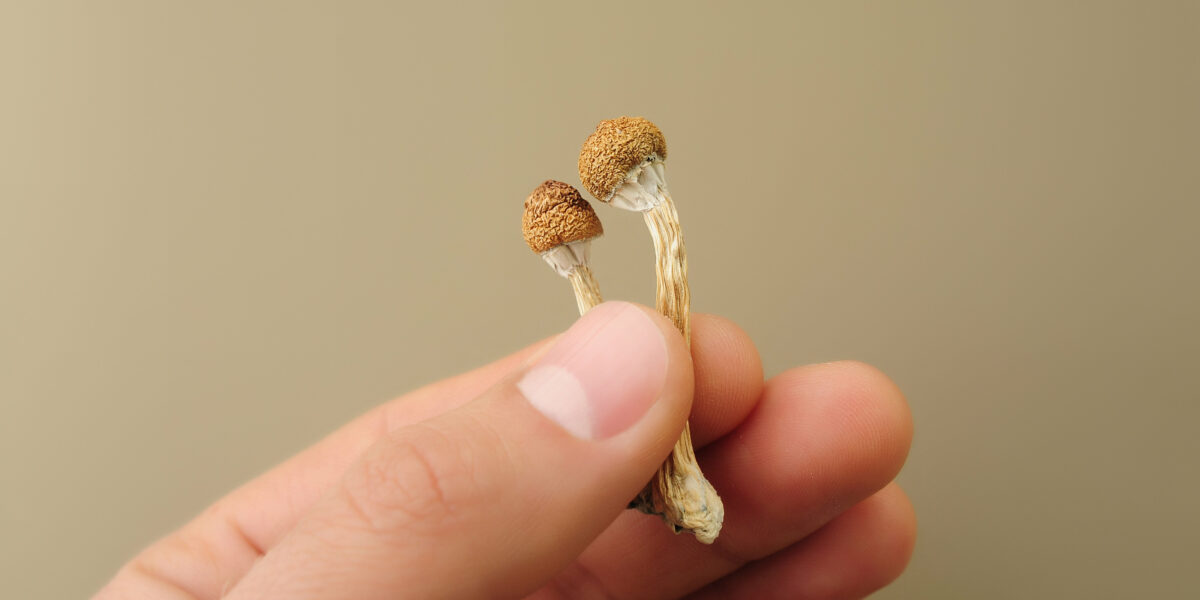
Psychedelics such as magic mushrooms have been shown to disrupt and desynchronise the brain, which may have an impact on spontaneous oscillatory activity where our rhythmic perception is reorganised. The increase in neural entropy under the influence of psilocybin may reduce the restrictions that we have surrounding our perception of rhythm, where it might become more fluid, fractal, or even synaesthetic, where sound and movement form into one unified flow. The reducing impact of a psychedelic such as psilocybin on the Default Mode Network might reduce our everyday way of creating more of a solid structure around our perception of rhythm, where we’re able to engage more with different potential rhythmic possibilities.
Other classic psychedelics, such as LSD, seem to have an impact on our appreciation of music, where the brain is engaging in more of a sense of wonder at the sounds, as well as having a deeper appreciation for the space in between the notes. One of my favourite things to do under the influence of LSD is listen to music, and I often find that if I’m listening to stimulating music, there is also a desire to move my body and manifest the physical sensations of the rhythm. In doing this, I feel connected to a wider fabric of creative expression, where I’m not bothered about how I look to others when dancing around because I’m in a pure state of flow. I often refer to it as locking into source energy, where I feel like I’m part of a deeper collective sense of rhythm that is greater than just my individual enjoyment of it. I also have a real fondness for playing music with my band while under the influence of small doses of LSD, as I find I’m able to really lock into the rhythm and feel more confident within a communal, unifying experience.
A similar example can be seen within the Shipibo tradition, where icaros are utilised to ground and guide participants within the ayahuasca experience. The effects of ayahuasca in combination with rhythmic singing can provide a strong vibrational container for the participant to be held by, which can allow for greater transformation within these kinds of settings.
The different cultural contexts for engaging with rhythm, especially when combined with different psychoactive plants or fungi, can create more potential for communal coherence and a sense of collective healing.
This has only been a brief exploration into the connection between rhythm, embodiment, and altered states of consciousness, but it’s clear to see that combining rhythm with psychoactive plants and fungi can greatly increase the impact that rhythm has on our lives. The benefit is that we can potentially draw ourselves away from the individualised healing narrative and engage more within embodied communal practices that benefit the wellness of our entire community.
While psychoactive plants and fungi might not have directly caused us to become rhythmic creatures, it seems that the introduction of these organisms might open up something within us that allows us to tap in more to a rhythmic way of being. We might think that we should be able to tap into this purely by ourselves, but there might be aspects of our lives which cut us off from this rhythmic part of ourselves, and we can utilise different plants or fungi to help possibly remove some of these aspects that create a barrier to the rhythmic expression.
When we consume psychedelics in safe environments, with people whom we trust and ideally in something of a communal environment, there is more potential for psychedelics to have an overwhelmingly positive impact on our rhythmic experience.
Our rhythmic experience can go beyond just practices which engage us in specific sonic expression, as there might be wider rhythms to life and nature that we can engage with through the use of psychedelics. In a 1987 interview titled Nature Is the Centre of the Mandala, Terence McKenna is quoted as saying:
…before technology, people had to store firewood in the autumn for the winter. And in the spring they had to sharpen tools for the late spring planting, and this sort of thing. That there was an implicit rhythm laid down by nature that entered the human cosmos at every level, and then was reflected in the poetry, the culture building, the language evolution, et cetera.
And between urbanization, other factors removed the influence of these rhythms, ending in the final culmination of the modern city where life under electric light goes on 24 hours a day. There’s then a flattening of the human dimension. There is no more a sense of being embedded in flux. There is instead the myth of eternal culture.
With this quote in mind, I think it’s quite fitting to look towards our engagement with rhythm as being a bridge between the biological natural world, the communal, and the cosmic.
Oli Genn-Bash | Community Blogger at Chemical Collective | linktr.ee/oligennbash
Oli is one of our community bloggers here at Chemical Collective. If you’re interested in joining our blogging team and getting paid to write about subjects you’re passionate about, please reach out to Sam via email at samwoolfe@gmail.com
Welcome to Chemical Collective.
Create an account to earn 200 welcome points.
Already have an account? Sign in
Check out our Community Blog and get involved with the conversation. You will be awarded 50 x ChemCoins for each comment up to a limit of 250 total ChemCoins.
Have you purchased any of our products? Reviews and reports are so important to the community. Share your honest opinion, and we’ll reward you with 50 ChemCoins for each review!
Every time you complete an order with us, you’ll be awarded ChemCoins for each Euro spent.
Welcome to Chemical Collective.
Create an account to earn 200 welcome points.
Already have an account? Sign in
Earn commission every time someone makes a purchase through your link.
When you become an affiliate, you will be allocated a unique link to share with your friends, followers, subscribers, or Aunt Susan.
You can choose to payout the commission earned once per month, or save it up to receive on a rainy day! Commission earned is 5% of the total order value per referral.
Contact us to join the Chemical Collective family and become an affiliate.
share your toughts
Join the Conversation.