Welcome to
Chemical Collective

Are you 18 or older?

Please confirm that your are 18 years of age or older.

You are not allowed to access the page.

info-icon €100 for domestic (NL, CZ, DE) €125 for the rest of the EU, excluding stealth shipping

Free shipping over €50 & free tracked shipping over €100

Friendly customer service available 9-5pm Monday to Friday

Free shipping over €50 & free tracked shipping over €100

Friendly customer service available 9-5pm Monday to Friday

Your cart is empty

Sound Baths and Altered States

oli-genn-bash

By Oli Genn-Bash

shutterstock 2133256897
in this article
  • Sound as a Technology for Altered States
  • The Science of Sound-Induced Altered States
  • The BAST “5Rs” Model of Experiential Processing
  • What Do People Experience in These Altered States?
  • Integration of Sound-Induced Altered States
oli-genn-bash

By Oli Genn-Bash

Disclaimer: The views and opinions expressed in this article are those of the authors and do not necessarily reflect the official policy or position of the Chemical Collective or any associated parties.

The fascination with altered states of consciousness has certainly become more of a topic of conversation with the increase in attention on psychedelic plants and fungi, but what if we don’t necessarily need to consume a mind-altering substance to get into an altered state? Are we even able to recognise this state once we arrive at it if we haven’t explicitly ingested something to get there? 

There’s certainly an argument to be had for being able to consume something that will predictably alter our consciousness, but it might be that we can explore more softer ways of reaching these points, which could potentially be less destabilising from a neurological point of view compared to psychedelics. There are also accessibility issues surrounding psychedelics when it comes to things like finances, physical disabilities, class, race, and government legislation, which can limit the consumption within structured and safe environments. With this in mind, we can look towards other entry points into these altered states, which might either be easier to access than psychedelics, or can provide an experience which feels safer and more grounded. 

Music and sound have always been a fascination of mine, and having been a musician for over 30 years, it forms the basis for a lot of my engagement with the world. I am often first aware of sounds when entering into a new environment before I have consciously processed the visual world, and I generally find I’m quite sensitive to any extreme changes in the audible environment. My experience of training as a practitioner in sound therapy with the British Academy of Sound Therapy (BAST) has added an extra dimension to the way in which I think about sound, not just in a musical sense, which has the power to entertain and inspire, but more so in a prescriptive way where the sound itself can provide a healing experience. 

Sound as a Technology for Altered States

The transformative and healing potential of sound has been known for tens of thousands of years, with groups such as Aboriginal Australians (who first migrated to the land between 50-65,000 years ago) engaging in ‘songlines’ which connect back to the ancestors and creator beings, where there is a focus on the health and wellbeing of the wider community. The didgeridoo, which is an iconic instrument in Australian Aboriginal culture, seems to have been used for the purposes of peace and healing for at least 1,500 years, although it might be much longer than that, given the migration which occurred tens of thousands of years earlier. Humans seem to have been making music for around 40,000 years, and it would seem that sound is one of the oldest portals available for entering into an altered state.

The use of sound in this context is a cross-cultural phenomenon, with practices such as shamanic drumming and chanting as examples which have a role in different societies across the globe. Before we’re born, we already have a felt sense of rhythm from inside the womb as our heartbeat synchronises with the heartbeat of our mother during rhythmic breathing. Our first experiences or initiation into this life is an encounter with rhythm, so it makes sense that something such as drumming has a universal appeal, especially when utilised within a group setting where finding rhythm together can assist with the health of the community. 

The word ‘shaman’ originates from Siberia, and drumming is an integral part of the practices from this region, where the frame drum (which is made by stretching animal skin over a wooden frame) plays a central role. The drum in this context isn’t seen as an instrument, but rather an essential tool for navigating the shamanic universe where different spirits and energetic forces are encountered. 

Among the Lakota and other Native American tribes, the drum occupies a central position of great importance and power, where, similarly to Siberian shamanism, it is more than just an instrument. Its power lies in connecting the community to the heartbeat of the Earth, and can be seen more like a living entity and spiritual guardian. The drum maintains tradition and old ways of life in a very real way, while also acknowledging the aliveness and health of the Earth. Those outside of Native American culture might view the skin of the animal and wood used to make the drum as being dead, but for those within the culture, the use of the drum maintains that life when the community hears its voice. 

This focus on the drum as a sonic tool to maintain the health of the community points towards the power of sound, almost in a prescriptive way, long before we started to understand the pharmacological or neurological pathways to altered states. Could it be that rhythm and vibration are fundamental to changing our state of consciousness? They could be seen as universal tools for achieving this, and often this happens quite quickly…almost as if we’re primed for this kind of experience.

Within my training as a sound therapist, I particularly enjoyed working with the frame drum, where we were instructed to utilise beats of 180bpm, which can shift our system into a theta brainwave state where we feel calmer and more relaxed. This seems to happen within the space of about five minutes of the drum being played, and it’s quite interesting to note how easily we shift into this space. Almost like our brains are just waiting for the moment where they can shift into this state where we’re feeling more at ease and potentially experience an altered state of consciousness. So what is actually going on when we experience this shift?

The Science of Sound-Induced Altered States

Similar to other animals, our brains perceive sound within the context of our primary warning system – is this sound something we need to be wary of and run away from, or is it something which is calming or nurturing? Our response to the sound might depend on the environment where it occurred, and how expected (or unexpected) the sound is. 

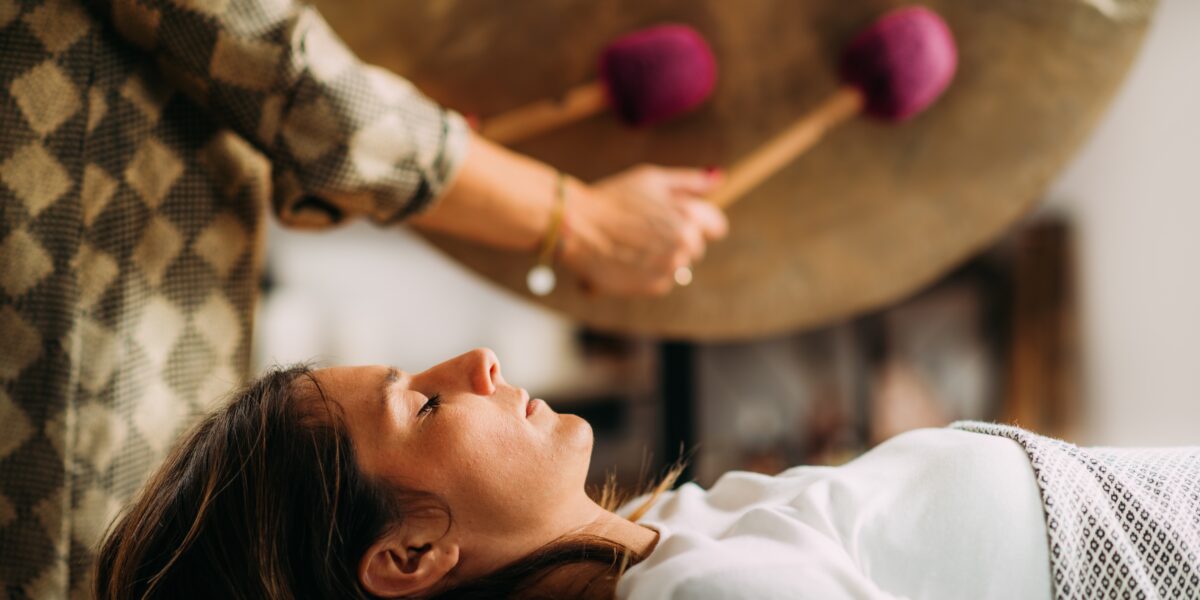
Sound baths – an experience where participants feel as if they are being “bathed” in the sound – have the ability to induce an altered state primarily through the concept of brainwave entrainment. This is where the oscillation of our brainwaves synchronises with the rhythm of external stimuli, such as speech, light, or sound, in this instance. Sustained acoustic frequency, such as pitch or a repeating pattern, created a drum beat, can influence the electrical activity within the cortical neurons, where they will adjust to synchronise with the periodic vibration of the external stimuli. 

This synchronisation can induce different brainwave states, primarily alpha and theta, which can allow us to enter into a state of deep relaxation. In this moment of deep relaxation, we’re able to quieten down our external responses to whatever is going on in our lives, and have the opportunity to explore more within ourselves. We might find that this opportunity for deep relaxation helps us to engage more with our parasympathetic nervous system, which provides an antidote for being in fight or flight and might be highly therapeutic for someone experiencing a state of fear or anxiety. 

Changes to our autonomic nervous system can also occur, where our heart rate and breathing slow down, as well as a sensation of vibrational resonance in the body, where we take notice of the different aspects of our physical body being more relaxed. 

We don’t necessarily have to think of an altered state in the same way as a psychedelic experience, but similarly, sound baths might provide an opportunity to engage with new sensations and different pathways, which can then induce neuroplasticity within the brain to reinforce this. This experience can also reduce the activity of the Default Mode Network, which is involved in the construction of our everyday waking experiences of reality. The reduction in this activity (similar to the mechanism of action that psilocybin mushrooms have) can play a role in quieting down certain pathways and softening the boundaries of the ego, where we can allow for the possibility of these new pathways to unfold.

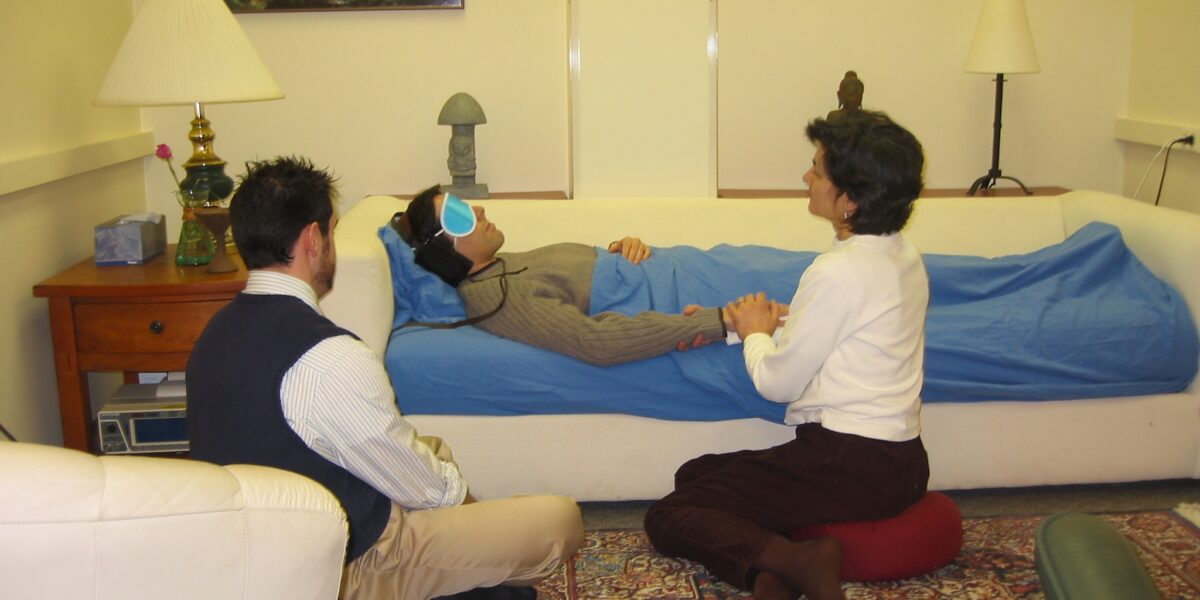
Within the context of a typical sound therapy session, there is a focus on what’s happening in the moment, where participants are invited to pay attention to the sensations within their body and where these sensations are located. They are then prompted to attach a colour or image to the sensation, as well as a sound, and ascribe something that this thing (whatever it is) might be saying to them – more specifically, what the narrative is. So, as an example, someone might be feeling anxious, and they sense it in their chest. It might look like a big jumbled-up ball of knots, which makes a high-pitched noise and says something to the effect of “you can’t leave the house and socialise!

We can often bring a lot of resistance to the situation if we’re experiencing continued sensations of anxiety over a long period of time. For anyone who’s gone through it, you know that anxiety is rather uncomfortable, and we’d like to do everything we can to simply not have to experience it. But does this resistance actually work to protect us in the long run, or does it create a separation between ourselves and what’s going on? In this separation, we’re not able to sit with these feelings of anxiety, and this creates a state of resistance, which in turn creates more suffering. Most people I meet have experienced states of anxiety, and it can really be quite debilitating for some individuals, where it feels like they won’t ever stop experiencing this. 

But where sound baths can assist is that they offer a new possibility, and a chance to be in a calmer state, where we can sit with what’s going on. In this moment, we can shift from resistance towards resonance. These concepts of resistance and resonance have informed my training in sound therapy, and they tie in with some wider concepts that can help us to explore the impact of these practices on our state of being. 

The BAST “5Rs” Model of Experiential Processing

Also known as the Cooper-Sax model, this provided the foundation of my training in sound therapy and has informed a lot of my own internal processing since undertaking the training. The 5Rs represent a process that we can’t escape from, where engaging with this process is vital for remaining in a state of flow, or what can also be referred to as ‘human flourishing’, where all the different aspects of our lives are operating in an optimal way. This might seem like a big task, but the combination of this model with different therapeutic sonic practices can provide a vibrational framework to engage with. We might feel like we can just think our way logically out of a situation or a negative sensation, but ultimately, this is all happening within the context of our body. We might be consumed by thoughts relating to situations, but we’re still a physical vessel which is impacted by these situations. 

Aside from resistance and resonance, the model also incorporates responsibility, reflection, and release. We can understand these “5Rs” in a way which leads us through the process required to achieve a state of human flourishing – firstly, we tend to resist what’s going on (this is only natural as humans, where we’re primarily concerned with our sense of safety) and then recognise where the resistance doesn’t serve us.

After this point of recognition, we can come to a point of resonance, where sitting with whatever is going on can allow us to work through it, and find new pathways which sit more comfortably. Someone might have never had an opportunity to experience a sound bath, and in potentially providing them with a new pathway, they might encounter moments of joy, and they feel hope in that they’ve been able to resonate with a positive experience. 

The responsibility aspect is key, as it’s important to recognise our own role in the healing process. The sound therapy sessions are always client-centred, where the practitioner is facilitating the experience, but empowering the client to find where it is that they need to go or where they’ve been holding onto tension. In taking responsibility over our own healing process, we are able to engage in reflection, which can allow us to become more aware of this healing process and feel empowered to integrate the experience. 

Getting to a point of release is how the experience can be truly transformative, where we’re no longer holding onto the things which aren’t serving us anymore. This can manifest in different ways, such as crying, laughing, or extreme bodily sensations, but when the energy moves and the barriers start to break down, we can find ourselves physically and mentally in a new space with more potential than we might have ever imagined. We might view this moment of release in a similar way to the concept of ‘ego death’ within psychedelic experiences, where we are able to encounter a revelation which allows us to break out of the ordinary confines of our consciousness and pursue a new pathway of possibility.

This process is by no means linear, and we can find ourselves in a state of flux between these different points, but it does provide some sense of structure to understanding how the power of sound can bring us into different states of awareness and guide the healing process. It might seem like a lot of pressure to feel like you have to get to a state of human flourishing where everything is functioning in an optimal way, but there’s not any sense of doing this wrong, as whatever comes up in the moment is what is there to be engaged with. 

What Do People Experience in These Altered States?

The impact of sound baths can be quite profound on our sense of self when grappling with the rigidity of the ego. The effect of different rhythms and tones using instruments such as gongs or Himalayan bowls can induce expansive sensations or a state of ‘oceanic boundlessness’. This is characterised by the dissolution of the ego, feelings of unity, and a sense of timelessness, which can have a profound impact on how we work through whatever is going on for us in the moment. We might not see this as necessarily going on for ‘us’, but instead get to a point where we are playing the role of a compassionate witness from an expanded state of being. The extended time that we feel within this experience might have allowed our system to slow down, where we really feel like we have an opportunity to explore sensations without a feeling of being rushed through something.

The somatic awareness, emotional release, and integrative insights that we find during a sound bath can provide something quite transformative in a profound way. Often, we might think that just taking the opportunity to slow down isn’t enough, but the power of utilising different instruments within this framework can really give us something which we might not have previously experienced. This sonic gift can provide us with a sense of hope and safety, perhaps knowing that there is the possibility for everything to be alright through being held in this space. Instruments such as the gong or Himalayan singing bowls can often be spoken about within the context of having a ‘sonic cuddle’, and I think it’s useful to think about sound baths in this way. We can attribute more to these tools than simply being instruments, where perhaps we view them similarly to the way in which the drum in Native American culture is viewed more as a method of communication and spiritual evocation. 
One study found that sound therapy (involving sound baths) could induce the following experiences in a statistically significant way:

  • Experience of unity
  • Positive mood
  • Insightfulness
  • Disembodiment
  • Complex imagery
  • Audio-visual synesthesia
  • Elemental imagery
  • Transcendence of time and space

As we can see, the use of sound baths can induce many of the same effects that psychedelics can, including more mystical effects. This isn’t to say a sound bath experience will be as intense as tripping; that would be unrealistic. But this research does illustrate how the mind-altering effects of sound baths are perhaps underappreciated.

Integration of Sound-Induced Altered States

Individuals might come to sound therapy for different reasons, and different kinds of sound baths can provide benefits in a wide variety of situations. People have experienced the relief of physical pain as well as emotional release, and the effect of sound baths might open up new ways of understanding the interplay between mind and body, where processing via sound and non-verbal pathways has more of an impact.

In supporting us through insight, transformation, and creative ways of understanding our life experiences, sound baths can utilise altered states of consciousness, similar to psychedelic therapy and other types of therapies that engage with our ego in a transformational way. While relaxation is a central focus of sound baths, the impact goes further than just allowing the body to calm down, and we can actually engage with experiences that take us quite far out of our usual confines. 

Sound baths are relatively accessible compared to other similar kinds of therapeutic experiences, and they offer a high degree of safety as a non-pharmacological ally to assist with the exploration of our inner worlds. The power of sound cannot be underestimated as a fundamental way to soften the ego and provide us with the possibility of new ways of reframing what is going on for us. The altered states that sound baths can induce offer an opportunity for individuals to go within, as well as providing something which might offer a connection to a wider story outside of the individual, where we’re able to come back to our communities with a different perspective and feel more comfortable with others. In this sense, we are really engaging with the prospect of human flourishing, where we can experience the joy of life in an interrelated way and find hope, which will ultimately inspire others to follow similar pathways.

Oli Genn-Bash | Community Blogger at Chemical Collective | linktr.ee/oligennbash

Oli is one of our community bloggers here at Chemical Collective. If you’re interested in joining our blogging team and getting paid to write about subjects you’re passionate about, please reach out to Sam via email at samwoolfe@gmail.com

share your toughts

Join the Conversation.

0 Comments
Inline Feedbacks
View all comments

Related articles

Our Products

Related Products

1V-LSD 150mcg Blotters

SALE! -35%

1V-LSD 150mcg Blotters From Original price was: €22.00.Current price is: €14.30.
(143)
1cP-LSD 100mcg Blotters

SALE! -20%

1cP-LSD 100mcg Blotters From Original price was: €18.00.Current price is: €14.40.
(137)
Tryptamine Mix and Match Pack (4 x 0.1g)

SALE! -20%

Tryptamine Mix and Match Pack (4 x 0.1g) From Original price was: €65.00.Current price is: €52.00.
(1)
1V-LSD 10mcg Micro Pellets

SALE! -35%

1V-LSD 10mcg Micro Pellets From Original price was: €15.00.Current price is: €9.75.
(43)
2-FDCK HCL

SALE! -20%

2-FDCK HCL From Original price was: €12.00.Current price is: €9.60.
(82)
1V-LSD 225mcg Art Design Blotters

SALE! -35%

1V-LSD 225mcg Art Design Blotters From Original price was: €35.00.Current price is: €22.75.
(62)
1S-LSD 150mcg Blotters

SALE! -20%

1S-LSD 150mcg Blotters From Original price was: €29.00.Current price is: €23.20.
(16)
1cP-LSD 150mcg Art Design Blotters

SALE! -20%

1cP-LSD 150mcg Art Design Blotters From Original price was: €25.00.Current price is: €20.00.
(74)
1V-LSD 225mcg Pellets

SALE! -35%

1V-LSD 225mcg Pellets From Original price was: €35.00.Current price is: €22.75.
(26)
1D-LSD 225mcg Pellets (1T-LSD)

SALE! -20%

1D-LSD 225mcg Pellets (1T-LSD) From Original price was: €42.00.Current price is: €33.60.
(13)
1cP-LSD 10mcg Micro Pellets

SALE! -20%

1cP-LSD 10mcg Micro Pellets From Original price was: €15.00.Current price is: €12.00.
(23)
5-MeO-DMT Freebase

SALE! -20%

5-MeO-DMT Freebase From Original price was: €23.95.Current price is: €19.16.
(36)
1S-LSD 10mcg Micro Pellets

SALE! -20%

1S-LSD 10mcg Micro Pellets From Original price was: €20.00.Current price is: €16.00.
(3)
O-PCE HCL

SALE! -20%

O-PCE HCL From Original price was: €17.50.Current price is: €14.00.
(25)
1cP-LSD 20mcg Micro Blotters

SALE! -20%

1cP-LSD 20mcg Micro Blotters From Original price was: €18.00.Current price is: €14.40.
(27)
rewards-icon
popup-logo

Reward program

popup-close
  • Earn
  • Affiliates