Welcome to
Chemical Collective

Are you 18 or older?

Please confirm that your are 18 years of age or older.

You are not allowed to access the page.

info-icon €100 for domestic (NL, CZ, DE) €125 for the rest of the EU, excluding stealth shipping

Free shipping over €50 & free tracked shipping over €100

Friendly customer service available 9-5pm Monday to Friday

Free shipping over €50 & free tracked shipping over €100

Friendly customer service available 9-5pm Monday to Friday

Your cart is empty

Psychedelics and the Hard Problem of Consciousness

david-blackbourn

By David Blackbourn

shutterstock 229039786
in this article
  • Why Does Anything Feel Like Something?
  • Enter Psychedelics
  • Materialism
  • The Default Mode Network
  • How Can Less Brain Activity Equate to More Consciousness?
  • Interface Theory
  • The Universe as Mind
  • Final Thoughts
david-blackbourn

By David Blackbourn

Disclaimer: The views and opinions expressed in this article are those of the authors and do not necessarily reflect the official policy or position of the Chemical Collective or any associated parties.

To understand why psychedelics are currently causing such a massive headache for the philosophical establishment, we first need to confront the most persistent and stubborn gap in modern science. A question so uniquely resistant to our standard means of investigation. The “Hard Problem” of consciousness.

The standard scientific story, taught to children the world over, goes something like this:

The universe is made of matter – atoms, quarks, electrons. None of these has an inner life; they just unconsciously bang into each other according to the laws of physics. Eventually, after billions of years of evolution, these unthinking, essentially lifeless atoms arranged themselves into complex biological machines. First single cells, then nervous systems, and finally the human brain itself. In a moment which looks suspiciously miraculous, suddenly this randomly constructed lump of grey meat begins to ‘feel’.

This is the central dogma of materialism – the brain generates consciousness in exactly the same way as a turbine generates electricity. Consciousness is an output.

In 1995, the Australian philosopher David Chalmers pointed out the fact that this story of how we came to be somewhat misses the point. He divided the study of the mind into two distinct categories: the “Easy Problems” and the “Hard Problem.”

Let’s be clear, the “Easy Problems” are incredibly difficult scientific challenges. The key point here is that they are solvable. These are considerations of the mechanics of perception. How does the eye process light? How does the brain store memory? How do we control our bodies? These are all questions related to function. They treat the brain as a complex computer, mapping the structure to explain its output. We may not have solved them all; there is obviously more to learn, but (in theory at least) we know how to solve them. For example, we can look at a brain scan, see the firing of neurons and say that those electrical signals are the brain processing a particular image or sensation.

The “Hard Problem” is a completely different beast altogether. It asks a question that it is seemingly impossible for structural or mechanical considerations to solve.

Why Does Anything Feel Like Something?

Let’s say we had a completely perfect, atom-by-atom map of the human brain, looking at the image of a rose. We can trace the photons bouncing off the rose and hitting the retina. The electrical signal travels the optic nerve, and the neurons fire in the visual cortex. We can measure the release of specific chemicals involved in this process. Nowhere in any of this swathe of data is the experience of the redness of a rose, its scent, perhaps the feeling of nostalgia, or warmth it may trigger.

Philosophers call these subjective experiences “qualia”. They could be described as the various sensations of reality, its texture, if you will – the redness of red, the hurt of pain, the taste of wine.

There is literally nothing in our current understanding of physics that explains why a specific arrangement of neurons might give rise to the feeling of love, for example, or the sting of a papercut. We could, theoretically, build a robot which behaves exactly as a human does, laughs at jokes, cries when in pain, etc. But, even though it appears to perfectly process all this data, is anyone actually home? Or, is it just an unconscious mechanism?

This is what is called the “Explanatory Gap.” Materialism says that matter creates mind, but it is unable to explain how that happens. It certainly provides no explanation at all for why.

Enter Psychedelics

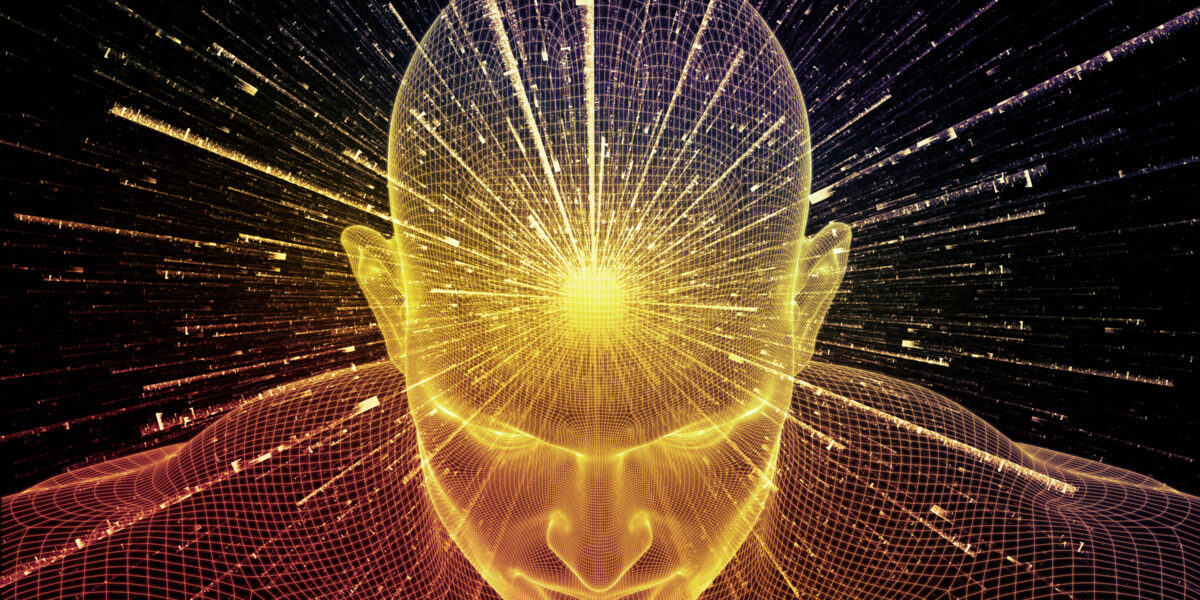
If the brain is responsible for generating consciousness, then altering its chemistry should create chaos, confusion, and a shattered awareness. To be fair, it often does. However, with substances such as psilocybin, LSD, and DMT, users report the exact opposite. Many users often report fantastical experiences which they describe as “more real than typical waking consciousness”. A hyper-aware state of consciousness where the self disappears completely, and the boundary between the internal and external world evaporates

This creates an incredibly interesting issue. Materialist science suggests that the brain is a consciousness generator, yet a subjective psychedelic experience seems to suggest otherwise. The Hard Problem is no longer just a debate for armchair philosophers, and the results are getting weird…

Materialism

Before we fall directly down the rabbithole (wormhole?) of galactic-scale minds (yes, really) we have to first consider the mainstream. While philosophers continue to debate the nature of the human soul, modern neuroscience has been busy. It has developed an extremely robust, sophisticated model to explain why psychedelics feel so incredibly profound. It achieves this without needing to abandon the conception of the brain as simply a biological machine. To the materialist, psychedelics do not open a portal to another dimension or remove the scales from your eyes; they simply crash the system.

The current theory is called “Predictive Processing.” This model suggests that what we witness as the world around us is, in fact, a powerful hallucination that the brain is constantly updating and optimising. Let’s put it simply:

The brain is locked inside the skull with no direct access to the external world. All it receives are chaotic electrical signals from the eyes, ears, skin, etc. To make sense of all this chaos, the brain does not simply record reality, like a camera. Instead, it maintains a constantly updating internal model of the world. This amounts to a best guess as to what should be out there, as opposed to what actually is. This means it needs only pay attention to sensory data when something contradicts its prediction – for example, a spider running up your arm.

This is, of course, a survival mechanism. Processing the sheer volume of data contained in raw perception in real-time would be incredibly slow and chemically challenging. Hallucinating a predictable world is much faster. Therefore, we live in a “controlled hallucination”, designed to keep us alive, rather than show us the truth of reality.

So, what happens when we introduce a psychedelic compound into this system?

The leading explanation comes from Dr Robin Carhart-Harris, of Imperial College London. He proposed the REBUS Model (Relaxed Beliefs Under Psychedelics). Harris argues that psychedelics chemically dismantle the brain’s top-down hierarchy. This weakens the day-to-day hallucination, removing all the associations and expectations connected to various aspects of the outside world. “This is a table”, for example, contains so, so, so many elements. As does “I am a separate self”.

When these elements of perception begin to disintegrate, the brain can no longer filter out the raw noise of existence. Suddenly, the floodgates open. Overwhelming sensory data, no guardrails or prior knowledge. The walls may begin to “breathe” because the brain no longer has an inbuilt prediction of what a wall is, whether it is static, whether it is even solid. The commonly reported feeling of oneness with the universe is not a rediscovered connection to some giant cosmic consciousness. Rather, the specific neural network responsible for the hallucination of “self” has simply been taken offline.

To the materialist, then, this profound, transcendent, revelatory space psychedelics allow us to enter is just another delusion. Beautiful perhaps, but a simple glitch nonetheless. The brain, stripped of its ability to predict, enters a state of plasticity (this is exactly why psychedelics are so potentially exciting in a therapeutic context).

This argument is pretty compelling because it is grounded in observable data. It explains the visual distortions, the dissolution of the ego, and the powerful emotions involved in perceiving “spirits” or alternate dimensions. In this view, while psychedelic effects are neatly explained away, the “Hard Problem” is far from solved.


The Default Mode Network

While viewing the psychedelic experience as a glitch is neat and tidy, there is a problem with this explanation. Some of the most significant neuroimaging data to emerge from the ongoing psychedelic renaissance clash with the theory entirely. If the brain itself generates consciousness, then the psychedelic experience – more vivid colours, more intense emotions, more complex associations – should create more brain activity, right? Wrong.

In a recent study from Imperial College London, 30 healthy volunteers had psilocybin infused into their blood while inside magnetic resonance imaging (MRI) scanners, which measure changes in brain activity. The scans showed that activity decreased in “hub” regions of the brain – areas that are especially well-connected with other areas.

During the peak of the psychedelic experience, blood flow and electrical activity did not spike in these key areas; they plummeted. Specifically, activity dropped in what is known as the Default Mode Network (DMN). The DMN can be seen as the brain’s organiser, or conductor, responsible for integrating information and maintaining a coherent sense of self.

This finding, which has now been replicated in studies with LSD and Ayahuasca, presents a profound paradox for the materialist view.

How Can Less Brain Activity Equate to More Consciousness?

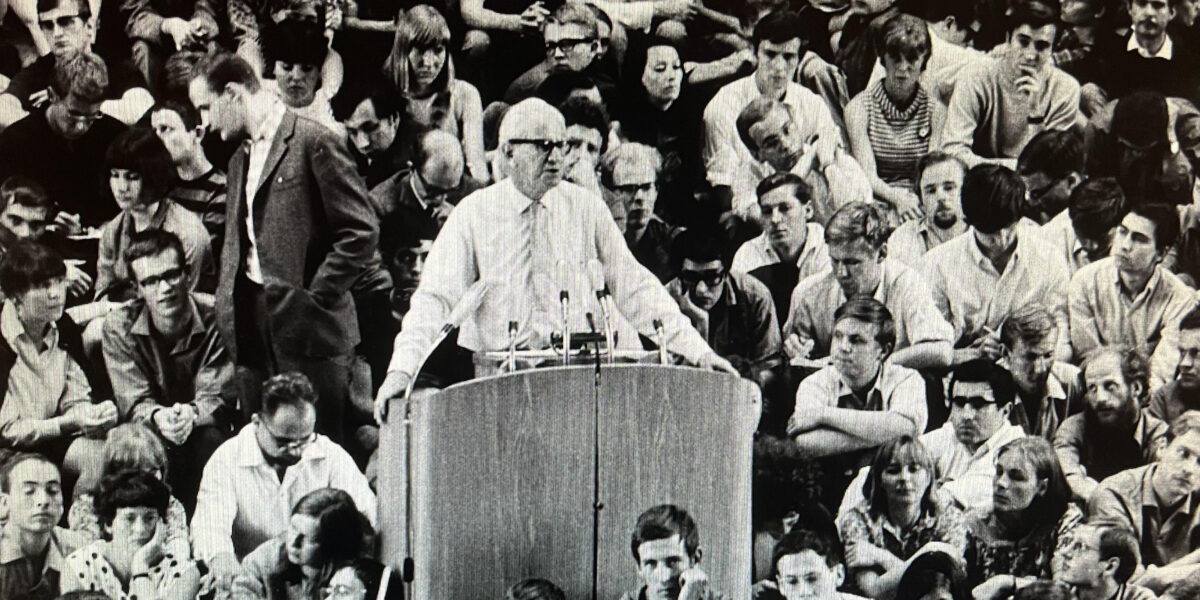
This new data has seen the reemergence of an only highly controversial theory championed by well-known author Aldous Huxley. In The Doors of Perception, Huxley argued that the brain is not a creator of consciousness, but rather a “reducing valve”.

This theory posits that the totality of all possible awareness is infinite and overwhelming. If we were constantly aware of absolutely everything, we would be utterly useless biologically. If you’re too busy staring in awe at the literal atoms vibrating in a leaf, you’re going to get eaten by a tiger… To ensure our survival, it was necessary for the brain and the nervous system to function as a funnel, filtering out the majority of reality, leaving only a “measly trickle”. This is basically just enough information to allow us to find food, shelter, and a mate, nothing more.

So, in this scenario, the psychedelic experience does not glitch the system, resulting in warped hallucinations. It chemically disables the filter, the “reducing valve”, and raw, unfiltered reality floods in. Rather than generating a fantasy, the brain is ceasing to censor the truth.

This aligns quite well with the subjective reports of users of psychedelics. People very rarely describe a trip as a confused stupor, which you would surely expect from a malfunctioning machine. More often than not, it is described as an expansion of consciousness, an awakening of sorts. If the reducing valve theory is correct, then the material assumption that the brain itself is “mind” is fundamentally backward. Here, the brain is an antenna, rather than the generator of a signal, which tunes down the frequency of reality so we can (somewhat) comprehend it.

Interface Theory

If the reducing valve suggests that we are only seeing a small part of the truth, a newer, even more radical theory suggests our idea of truth does not exist. We are, in fact, dumbly gazing at the dashboard of a user-friendly interface, hiding the true, terrifying complexity of the machine as a whole.

This is the “Interface Theory of Perception”, championed by the cognitive scientist Donald Hoffman. Hoffman spent many years running evolutionary game theory simulations. These are complex mathematical models that are designed to test scenarios in which organisms may or may not survive. Hoffman’s results are jarring. In almost every simulation, organisms that evolved to see reality “as it is” go extinct. Whereas those tuned to solely “useful” information survived. Therefore, we can see perception as like a computer desktop, providing simplified icons to guide our actions, while hiding the complex reality behind them.

You could think of it like this: So, you are writing an email on your computer. On your screen, there is a blue icon which represents that specific file. The file itself, however, is not blue or rectangular at all. Those are just pixels. In fact, the “reality” of that particular file is a string of binary code, data on an SSD. The icon is useful in that it allows us to use the machine. But it does not show us reality; it acts as a simplified interface.

Hoffman argues that the three-dimensional space we move through, the clock on the wall, etc., is just our equivalent of the desktop. Physical objects in space are merely icons. A snake, for example, is not a snake in and of itself; it is a data structure that our brain renders as DANGEROUS SLITHERING THING – DO NOT TOUCH.

From this perspective, standard materialism makes a critical error. Trying to find consciousness inside the brain is analogous to tearing apart your laptop to find the little blue email icon. Yet the hardware itself? Just another icon.

So, how do psychedelics fit into this perspective? If our daily reality is equivalent to a VR headset designed to keep us alive, psychedelics are a hack. They glitch the software. Rather than destroying consciousness as a result, as with materialist assumptions, they dissolve the “icons” to show us the system beneath.

Hoffman posits that substances like DMT could “[open] us up to new levels of reality that are genuine insights.” When a user on DMT reports seeing complex geometry, Hoffman suggests they may, in fact, be momentarily seeing behind the user interface, glimpsing the raw data of consciousness.

The Universe as Mind

If the idea of living behind a simplified, desktop interface seems radical, there is a final theory that takes it even further. It doesn’t just question our perception of reality; it questions the substance of reality itself. This is “Analytic Idealism”. The main proponent of this theory is former CERN engineer, Berdardo Kastrup. Kastrup argues that the entire “Hard Problem” does not exist. We are frantically attempting to understand how it is possible that “dead” matter can generate consciousness. But, what if matter itself does not exist?

This does not mean, for example, that the chair you are sitting in is not real. It means that the chair is not a physical thing that exists independently of the mind observing it. Analytic Idealism argues that consciousness, rather than the atom, is the fundamental building block of the universe.

To a materialist, consciousness is an evolutionary accident at the tail end of billions of years of development. To the idealist, consciousness is effectively the canvas on which the entire universe is painted. Everything that makes up the physical world – atoms, stars, neurons in our brains – is just an image of the underlying consciousness.

Analytic Idealism suggests that the universe is essentially a single mind on a cosmic scale. You, me, your dog, could all be aspects of this universal consciousness. We are all alters, dissociated from the whole. As Kastrup describes it: “living beings are dissociated aspects of [a] broad field of subjectivity.

Relating this back to the psychedelic experience, then. If we are all just dissociated aspects of a universal consciousness, then the boundary separating you and me, or me and the universe as a whole, is nothing more than a mental wall. Kastrup argues that psychedelics break this wall and reduce our innate dissociation. In a strange way, in this context, you could think of a psychedelic as a medication which cures the universe’s multiple personality disorder.

Final Thoughts


For decades, materialist science has tried to sweep the anomaly of consciousness under the rug. Dismissing the psychedelic experience as simply a glitch or solely hallucinations appears to discount a lot of the new data. The drop in brain activity during the peak of a trip, for example, is not at all explained by this old model of thinking.

The brain-centric view of reality, brain as consciousness generator, falls apart under scrutiny. It works fine to explain the “Easy Problems” of mechanics, just as Newtonian (apple, head, ouch) physics works fine for constructing a house. However, in the realm of subjective experience? Nothing.

Whether the answer lies in Huxley’s “Reducing Valve”, Hoffman’s “Interface Theory”, or Kastrup’s “Idealism”, the direction of travel is clear. As we did with the earth and its seemingly central position in the heavens, we are moving away from the arrogant assumption that we, the brain, are likewise. We are moving towards a model that places consciousness as opposed to dead matter at the centre of the picture.

This does not mean we can immediately abandon scientific rigour and scepticism; far from it. It does, however, call for a profound change in our thinking. We must, as ever, admit that we are apes with limited sensory means trying to understand infinity.

The “Hard Problem” may well be a trick question. Asking how the brain creates conscious experience, assuming this reality is fundamental, is like looking for a newsreader inside your TV. You can take it to bits as much as you want, reconstruct it, find how it works in ever-increasing detail, but you are never, ever going to find them in there.

David Blackbourn | Community Blogger at Chemical Collective

David is one of our community bloggers here at Chemical Collective. If you’re interested in joining our blogging team and getting paid to write about subjects you’re passionate about, please reach out to Sam via email at samwoolfe@gmail.com

share your toughts

Join the Conversation.

0 Comments
Inline Feedbacks
View all comments

Related articles

Our Products

Related Products

1V-LSD 150mcg Blotters
1V-LSD 150mcg Blotters From 22.00
(143)
1cP-LSD 100mcg Blotters
1cP-LSD 100mcg Blotters From 18.00
(137)
Tryptamine Mix and Match Pack (4 x 0.1g)
Tryptamine Mix and Match Pack (4 x 0.1g) 65.00
(1)
1V-LSD 10mcg Micro Pellets
1V-LSD 10mcg Micro Pellets From 15.00
(43)
2-FDCK HCL
2-FDCK HCL From 12.00
(82)
1V-LSD 225mcg Art Design Blotters
1V-LSD 225mcg Art Design Blotters From 35.00
(62)
1S-LSD 150mcg Blotters
1S-LSD 150mcg Blotters From 29.00
(16)
1cP-LSD 150mcg Art Design Blotters
1cP-LSD 150mcg Art Design Blotters From 25.00
(74)
1V-LSD 225mcg Pellets
1V-LSD 225mcg Pellets From 35.00
(26)
1D-LSD 225mcg Pellets (1T-LSD)

SALE! -15%

1D-LSD 225mcg Pellets (1T-LSD) From Original price was: €42.00.Current price is: €35.70.
(13)
1cP-LSD 10mcg Micro Pellets
1cP-LSD 10mcg Micro Pellets From 15.00
(23)
5-MeO-DMT Freebase
5-MeO-DMT Freebase From 23.95
(36)
1S-LSD 10mcg Micro Pellets
1S-LSD 10mcg Micro Pellets From 20.00
(3)
O-PCE HCL
O-PCE HCL From 17.50
(25)
1cP-LSD 20mcg Micro Blotters
1cP-LSD 20mcg Micro Blotters From 18.00
(27)
rewards-icon
popup-logo

Reward program

popup-close
  • Earn
  • Affiliates