in this article
- The New Sensibility
- The Great Refusal
- Marcuse and the Counterculture
- Mark Fisher - Acid Communism
- Marcuse and the Psychedelic Renaissance
- Commodification of the Psychedelic Experience
- Final Thoughts
Are you 18 or older?
Please confirm that your are 18 years of age or older.
You are not allowed to access the page.
Disclaimer: The views and opinions expressed in this article are those of the authors and do not necessarily reflect the official policy or position of the Chemical Collective or any associated parties.
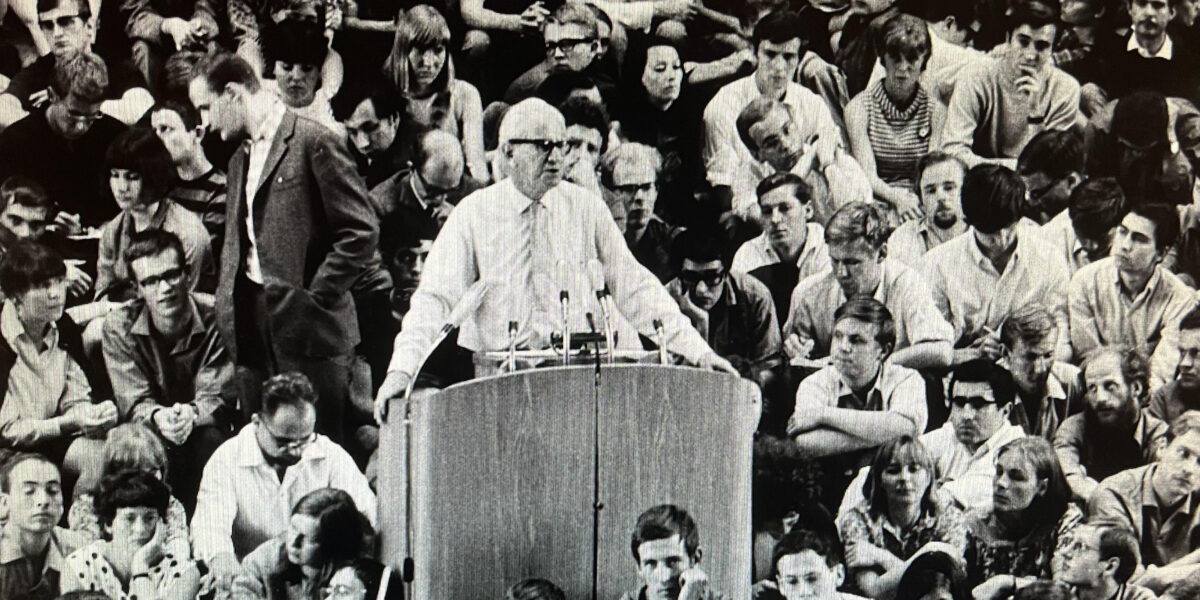
In July 1967, the Roundhouse in London, a gigantic former railway engine shed, became the epicentre of a global intellectual explosion. The “Dialectics of Liberation” congress brought together a wide variety of influential schools of thought – from Marxist theorists to antipsychiatrists, to Black Power activists.
Amidst a haze of tobacco smoke stood Herbert Marcuse: a grey-haired refugee from Nazi Germany and a founding member of the Frankfurt School – a school of social theory and critical philosophy associated with the Institute for Social Research, at Goethe University. Marcuse was an unlikely icon for the growing counterculture. However, as he spoke to a crowd of young people aching for change, it was clear that his ideas could provide a kind of intellectual grounding for their movement.
Marcuse bridged the gap between the economic critique of Karl Marx and the psychological insights of Sigmund Freud. In doing so, he identified the strange pathology of the modern world.
To understand Marcuse’s eventual interest in psychedelics, first we have to consider his concept of the “One-Dimensional Man”.
For Marcuse, capitalism in the West was a means of oppression that no longer required military force (at least against your own populace). Rather, the West employed something ultimately more sinister, what Marcuse described as a “comfortable, smooth, reasonable, democratic unfreedom.” He argued that the system has become so adept at satisfying what he dubbed our “false needs” that it smothers our capacity to even imagine a different way of life. We’re all so bogged down in our desires – a better TV, a new car, some other shiny, new gadget, which results in the “suppression of individuality in the mechanisation of socially necessary but painful performances.” Our entire value is inextricably tied to productivity and consumption. The real tragedy, the truly insidious element of this is that we are not being actively denied what we want; rather, we have been conditioned to want the things which keep us enslaved.
This creates a pretty profound issue for the traditional revolutionary. If the working class had been indoctrinated into the system via consumerism, where would even the desire for rebellion come from? Marcuse’s answer was a wholesale rejection of the established way of life. A political refusal was not enough; this had to be what he called the “Great Refusal”, a complete shift in consciousness.
This shift in consciousness, Marcuse’s “New Sensibility”, is exactly the point at which his theories and the psychedelic experience begin to converge.
Marcuse recognised that the substances the youth had begun to experiment with in the 1960s (LSD, psilocybin, mescaline) were revolutionary in and of themselves. They shatter the ego and dissolve the usual normality of the system as a whole. The “false needs” become apparent for what they truly are – mere absurdities. Marcuse viewed these substances not as drug-fuelled escapism, but rather as potential, powerful catalysts for change.
For Marcuse, the failure of previous socialist revolutions lay in their inability to transform the human being. “If an advanced society…makes scientific and technical progress into an instrument of domination. “Progress” is not a neutral term.”
He argued that if a revolution merely changes the ownership of the means of production without changing the “nature” of the people involved, it simply recreates the old patterns of dominance and aggression under a new flag. Society required what he termed a:
new sensibility, that is, a reshaping of human relationships with each other as well as with nature would usher in a new reality principle. With this new reality principle would come a new mission or telos for technology.

In his works Eros and Civilisation and the later An Essay on Liberation, he proposed a provocative and deeply biological thesis: for a revolution to be successful, it must be rooted in a “new sensibility.” Freedom, he argued, must become a biological necessity, an instinctual drive as powerful as the need for food or sex.
This “new sensibility” was Marcuse’s answer to the “performance principle”, the capitalist demand that we suppress our desires for pleasure and beauty in favour of efficiency, competition, and struggle. Under this principle, the human body is treated as a tool, and the mind as a processor of tasks. Marcuse saw this as a form of “surplus repression” that had stunted our evolution. He dreamed of a society where the “aesthetic dimension” would be primary, where life would be lived as a form of play rather than a cycle of labour. He called for a “reconstruction of the technical apparatus” of society, guided by individual human experience.
It is precisely at this juncture that the psychedelic experience becomes a vital Marcusian tool. The primary characteristic of the psychedelic state is the suspension of the “performance principle.” In the peak of an LSD or psilocybin experience, the usual value of objects vanishes. A chair is no longer just something to sit on; it becomes a shimmering, vibrating something, shorn of all societal trappings. This is the “aesthetic dimension” breaking through the “one-dimensional” fog. The trip provides a temporary, but visceral, experience of what Marcuse meant by a world governed by beauty rather than utility.
Furthermore, the ego-dissolution common to deep psychedelic states serves to undermine the “aggressive” and “possessive” self that capitalism requires. Marcuse argued that our current biology is “aggressive”; we are conditioned to see the world as a collection of resources to be mastered and competitors to be defeated. The psychedelic experience, by contrast, often fosters a sense of “oceanic” interconnectedness, a feeling that the boundary between the self and the environment is a fragile illusion. This is the “non-aggressive” sensibility Marcuse sought. It is the biological realisation that we are part of the “flesh of the world” (to borrow from Merleau-Ponty), and that to harm the world or our neighbour is to harm ourselves. In this light, the psychedelic “new sensibility” is not just a personal insight; it is a prerequisite for a politics of peace and ecological sanity.
The defining tension in Marcuse’s engagement with the psychedelic movement was his fear that the trip might become a trap. While he saw the potential for a “new sensibility,” he was acutely aware of the system’s ability to neutralise rebellion by absorbing it. This is the core of his theory of “repressive desublimation.” Marcuse argued that late-capitalist society is uniquely capable of permitting a certain degree of freedom, be it sexual liberation, experimental art, or drug use, as long as that freedom does not threaten the underlying economic and political structures. In this scenario, the rebellion becomes nothing more than a societal safety valve, a commodified lifestyle choice that actually reconciles the individual to their own servitude.
Marcuse’s concern was that the “Turn On, Tune In, Drop Out” ethos of Timothy Leary risked falling into this very trap. If “dropping out” meant merely a passive withdrawal into a private world of colourful visions, it was not a revolution; it was a vacation. He feared that the psychedelic experience could be used as a form of psychic protection, to help the “one-dimensional man” cope with his alienation rather than end it. If the drug allowed the worker to endure a soul-crushing job by providing a weekend of relief and release, then the drug was serving the performance principle, not destroying it.
The alternative to this passive absorption was the “Great Refusal”. This was Marcuse’s term for the total, uncompromising rejection of the rules of the game.
The “Great Refusal” is not just disagreeing with a specific policy; it is a resounding NO to the entire logic of a system that prioritises profit over life.
For psychedelics to be a tool of the “Great Refusal”, they had to do more than provide a good trip. They had to facilitate what pretty much amounted to a complete destruction of the ego. This would cause a permanent rupture in the individual’s position in and understanding of the capitalist world as a whole.
When the psychedelic experience is harnessed as part of the “Great Refusal,” it reveals the “false needs” of society. The individual returns from the experience unable to look at a billboard, a corporate hierarchy, or a military-industrial complex with the same “one-dimensional” acceptance. The “aesthetic dimension” revealed by the substance becomes a permanent standard against which the ugliness and violence of the status quo are judged. In this Marcusian framework, the psychedelic experience is only truly revolutionary when it leads the individual back into the world with a heightened sense of alienation, a refusal to be integrated, and a biological need for a reality that matches the beauty and unity they have witnessed. This can obviously be pretty unpleasant for an individual to tackle and comes with some definite risk.
While Marcus may appear to have held a position as somewhat of a mentor for the growing counterculture, it was a movement he frequently critiqued. He was seemingly both fascinated and frustrated. While activists like Abbie Hoffman and Angela Davis looked to Marcuse for the theoretical justification for their radical activism, he was more distant. Marcuse was a product of the European high-culture tradition, a man who deeply valued intellectual discipline and the transformative power of what might be deemed “serious” art. This made him somewhat wary of some of the chaotic, anti-intellectual, even fully “woo-woo” undercurrents of the hippy movement.
His main hesitation with the psychedelic movement (a concern which I personally feel came to pass in a lot of ways) was the risk of a kind of “artificial…“private” liberation.” He described the “kernel of truth” of the psychedelic experience as the revelation of the necessity for revolution. However, “its narcotic character brings temporary release not only from the reason and rationality of the established system but also from that other rationality which is to change the established system.”
Simply put, a psychedelic may reveal the madness of industrial society, but without concerted, sober action outside of the altered state, it simply “creates…artificial paradises within the society from which it withdrew.” This means it is nothing more than a temporary panacea. Individuals are still “subject to the law of…society”. A stoned population, too inwardly focused, plays right into the hands of the state.
However, away from the “flower power” elements of the movement, Marcuse was more positive. The Youth International Party (often called the “Yippies”), the radical student group, gave him hope. Their genuine attempt to enact his “Great Refusal” in a way which combined politics with the “new sensibility” gave Marcuse reasons for cautious optimism. He began to theorise that the ego-dissolution caused by psychedelics could be the starting point for a new, more collective ego. This ego would be less aggressive and more cooperative. He saw the potential for the “aesthetic dimension” to emerge from museums and art galleries and into the streets. The manifestation of this was the bright, theatrical, hugely disruptive protests which defined this era.
While Marcuse’s direct influence on the counterculture waned somewhat after the 1970s, his ideas found new life in the late 2010s through the work of the British cultural theorist Mark Fisher. In his unfinished final project, titled Acid Communism, Fisher sought to reclaim the radical potential of the 1960s from the neoliberal narrative that had reduced the era to a mere explosion of hedonism and fashion. Fisher’s project was, at its heart, a Marcusian one. It was an attempt to understand how the psychedelic movement had briefly made a new society, and a completely different world appear not only possible, but inevitable.
As explored in the introductory fragments of Acid Communism, Fisher identified a specific moment in the late 1960s where the “new sensibility” Marcuse theorised began to merge with democratic socialism and experimental culture. Fisher called this “Acid Communism”, a state of mind where the shattering of the ego led not to a private retreat, but to a collective realisation that the state of the world is not this immutable, static, natural thing. For Fisher, the psychedelic experience was a weapon against “capitalist realism.” This is the commonly parroted view that capitalism is the only viable political and economic system. The psychedelic experience acted as a visceral proof that reality is far more wobbly and ephemeral, and that the “one-dimensional” world of work and debt is a fragile construct that could be dissolved.
Fisher’s Marcusian ghost haunts our current era because he identified exactly how the “Great Refusal” was defeated. He argued that the neoliberal revolution of the 1980s was a direct response to the threat of Acid Communism. The system did not just suppress the psychedelic movement; it stole its energy and commodified it. It took the desire for self-actualisation and consciousness expansion, and rebranded them as personal development and wellness. This is a classic case of Marcuse’s “repressive desublimation.”
The radical demand for the abolition of labour was replaced by the gig economy, in which the individual is “free” to be their own (exploited) boss. As noted in contemporary critiques of Fisher’s work, the “acid” was removed, leaving only a hollowed-out individualism that serves the performance principle more efficiently than ever.
By connecting Marcuse to the 21st century, Fisher highlights the lost futures that we are still struggling to reclaim. Such profound realisation and promise, subsumed back into the corporate, capitalist system. Acid Communism was the promise of a society where technology was used to reduce labour, and where the “aesthetic dimension” was the primary focus of human life. It was the Marcusian dream of a non-aggressive civilisation. Fisher’s work suggests that the task of the modern psychonaut is not just to have a healing experience or personal journey, but to use that experience to rediscover their true potential to imagine.
The current psychedelic renaissance presents a fascinating potential case study for Marcusian theory. As these substances move from the underground into the clinical laboratory, they are being reframed as tools for mental health and resilience. While the therapeutic benefits are undeniable, a Marcusian analysis asks a critical question: what are we being healed for? If psychedelic therapy is used primarily to help the individual adjust to a dysfunctional society, to return to their “one-dimensional” job with a more positive mindset, then it risks becoming the ultimate form of repression.
Research published in the Journal of Psychedelic Studies and elsewhere has begun to evaluate the role of these substances in addressing “societal alienation.” From a Marcusian perspective, alienation is not a medical condition to be cured; it is a rational response to an irrational system. If the shattering of the ego during a psilocybin session reveals the false importance of an individual’s role in society and the emptiness of consumerist culture, that is a moment of profound political insight. The danger of the medicalisation of psychedelics is that it seeks to neutralise this insight, treating the individual’s political dissatisfaction as a brain imbalance to be corrected.
However, there is a counter-current within modern research that suggests the Marcusian “new sensibility” can still emerge within the clinical setting. Some studies into “imaginaries of liberation” suggest that psychedelic experiences can foster a deep sense of connection with nature and social attitudes that are fundamentally at odds with the “performance principle.” These experiences can lead to a profound change in mindset. This can make the “one-dimensional” life appear intolerable. The psychedelic experience can act as a catalyst for what Marcuse called the “reconstruction of the technical apparatus”, a desire to use one’s life and skills for something other than the perpetuation of the status quo.
The challenge for the modern era is to prevent psychedelics from becoming just another control mechanism. For them to remain potentially powerful tools of liberation, they must maintain their “aesthetic” and “disruptive” power. They must be allowed to foster a “new sensibility” that is not just healthier, but more demanding, a sensibility that refuses to be satisfied with “the illusion of rebellion.” In this light, the goal of psychedelic therapy should not just be the recovery of the individual, but the recovery of the radical imagination, the ability to see beyond the “one-dimensional” horizon and demand a world that is different.
We live in an era where the counterculture is no longer a threat to the system. It has, in a lot of ways, unfortunately, become just another fuel. This is the era of corporate psychedelia. where the “Great Refusal” has been packaged and sold back to us as a high-end commodity.
From Silicon Valley executives microdosing for “increased productivity” to luxury retreats in the jungle, the psychedelic experience is being integrated into the “performance principle” with frankly terrifying efficiency. This is what Marcuse might call “Repressive Desublimation 2.0”. The system allows (and progressively encourages) expanded consciousness specifically because it makes the individual a more creative, more resilient, and more productive “one-dimensional” worker. This completely negates the potential of these substances to act as agents for change and evolution of society as a whole.
The system is incredibly adept at absorbing the “aesthetic dimension” and turning it into nothing more than the aesthetics of the experience – the visuals, not the insights. The surface level, the vibrant colours, and the temporary sense of oneness are used to sell everything from clothing to software. The radical political demands that should, according to Marcuse, accompany the experience are quietly discarded. This commodification creates a hollowed-out psychedelia, an experience that provides the feeling of liberation without any sort of liberation actually occurring.
To Marcuse, a productivity-enhancing microdosing protocol is the opposite of liberation. The goal is now to tighten the ego’s grip on the already existing world of work with substances that have the ability to shatter it completely. The danger is that as psychedelics become mainstream, they will be stripped of their ability to disagree with the world as it is. They will be turned into positive tools for living more comfortably within a horrifically abusive system of control.
To resist this commodification, we must return to Marcuse’s insistence on the “new sensibility” as an aesthetic and biological revolt. A genuine psychedelic liberation cannot be purchased or integrated into a corporate workflow. It must remain unproductive in a capitalist sense. It must lead to a “Great Refusal” of the very structures that are currently trying to sell it back to us.
Herbert Marcuse’s philosophy serves as a powerful reminder that the psychedelic experience is never just about the individual. His work provides the missing link between the internal, subjective experience of expanded consciousness and the external, objective task of social transformation. He taught us that for a revolution to be real, it cannot be commodified. Psychedelics can be a catalyst for his “new sensibility,” exposing the “false needs” of our current “one-dimensional” existence.
However, he left a vital warning about the traps of liberation, or the sensations of perceived liberation. He showed us how the system can absorb rebellion and turn it into just another means of control. Expanded consciousness can be co-opted to reinforce the “performance principle” rather than destroy it.
In the era of the psychedelic renaissance, Marcuse’s critique is more urgent than ever. He challenges us to ensure that our use of psychedelics leads to a “Great Refusal”, a total rejection of a system that prioritises profit over the “aesthetic dimension” of life.
Ultimately, psychedelics are not the revolution, but they have the potential to be a spark that makes the revolution imaginable. They provide a temporary glimpse of a different world, revealing the ugliness and violence of our society. The goal, as Marcuse and later Mark Fisher suggested, is to move from the individual trip to the transformation of the social fabric itself. Destroying the ego to build a more collective ego that is no longer satisfied with “comfortable unfreedom.” By reclaiming the radical imagination, we can begin to demand, and build, a world that is no longer “one-dimensional,” but vibrant, unified, and beautiful.
David Blackbourn | Community Blogger at Chemical Collective
David is one of our community bloggers here at Chemical Collective. If you’re interested in joining our blogging team and getting paid to write about subjects you’re passionate about, please reach out to Sam via email at samwoolfe@gmail.com
Welcome to Chemical Collective.
Create an account to earn 200 welcome points.
Already have an account? Sign in
Check out our Community Blog and get involved with the conversation. You will be awarded 50 x ChemCoins for each comment up to a limit of 250 total ChemCoins.
Have you purchased any of our products? Reviews and reports are so important to the community. Share your honest opinion, and we’ll reward you with 50 ChemCoins for each review!
Every time you complete an order with us, you’ll be awarded ChemCoins for each Euro spent.
Welcome to Chemical Collective.
Create an account to earn 200 welcome points.
Already have an account? Sign in
Earn commission every time someone makes a purchase through your link.
When you become an affiliate, you will be allocated a unique link to share with your friends, followers, subscribers, or Aunt Susan.
You can choose to payout the commission earned once per month, or save it up to receive on a rainy day! Commission earned is 5% of the total order value per referral.
Contact us to join the Chemical Collective family and become an affiliate.
share your toughts
Join the Conversation.