Welcome to
Chemical Collective

Are you 18 or older?

Please confirm that your are 18 years of age or older.

You are not allowed to access the page.

info-icon €100 for domestic (NL, CZ, DE) €125 for the rest of the EU, excluding stealth shipping

Free shipping over €50 & free tracked shipping over €100

Friendly customer service available 9-5pm Monday to Friday

Free shipping over €50 & free tracked shipping over €100

Friendly customer service available 9-5pm Monday to Friday

Your cart is empty

Entering the Hypnagogic State Through Yoga Nidra

sam-woolfe

By Sam Woolfe

shutterstock 2225800379
in this article
  • What Does Yoga Nidra Involve?
  • Yoga Nidra and Hypnagogia
  • The Potential Benefits of Hypnagogia
  • Can We Enhance Yoga Nidra-Induced Hypnagogia?
sam-woolfe

By Sam Woolfe

Disclaimer: The views and opinions expressed in this article are those of the authors and do not necessarily reflect the official policy or position of Chemical Collective or any associated parties.

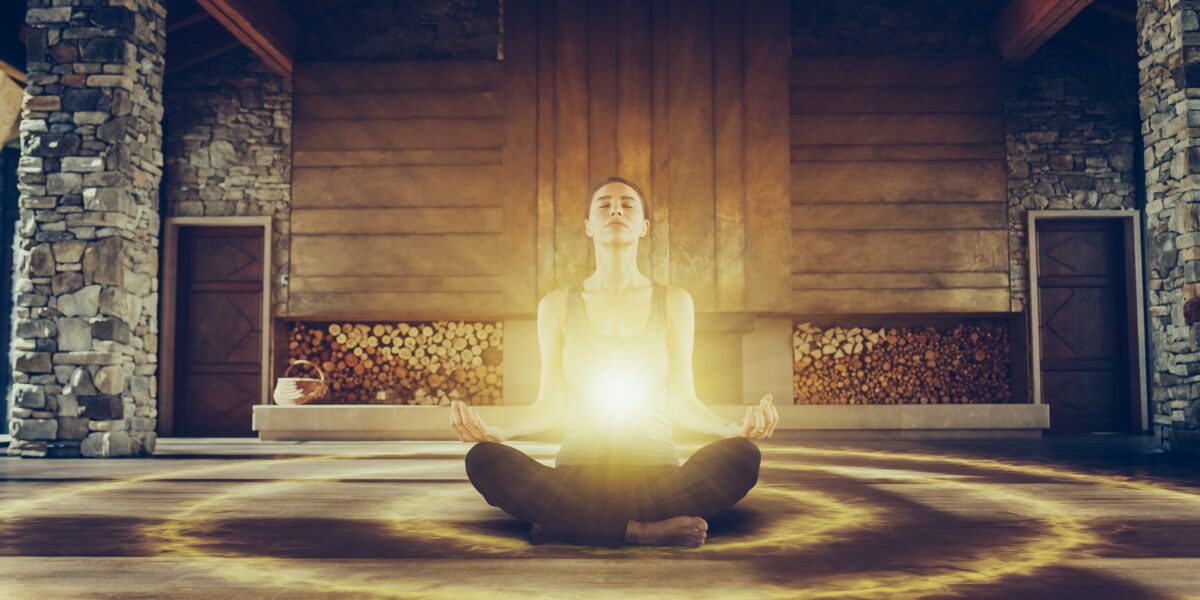
Yoga nidra (or yogic sleep) is a technique for inducing a state of consciousness between waking and sleeping. I often use it when I’m sleep-deprived, either as a way to (hopefully) have a nap, or at least to feel more rested, which can happen without needing to sleep. Research is also emerging on the benefits of yoga nidra, including its ability to improve sleep quality and duration, as well as cognition.

While the term yoga nidra can be found in ancient Hindu texts, including the Upanishads and Mahabharata, as well as in Shaiva and Buddhist tantras, it is referred to as a meditative state. These ancient texts don’t provide a precedent for the modern technique of guided meditation that characterises yoga nidra today. This technique is derived from 19th- and 20th-century Western ‘proprioceptive relaxation’, used by practitioners such as Annie Payson Call and Edmund Jacobson. Their work on progressive relaxation methods, which emphasised muscle relaxation and breath awareness, would lay the foundations for yoga nidra. 

Swami Satyananda Saraswati is often credited as the pioneer of modern yoga nidra, who, in the 1960s, developed a systematic approach to the practice, involving meditation and deep relaxation. Dennis Boyes later wrote about yoga nidra in his 1973 book The Yoga of Waking Sleep, which describes the modern technique, introducing and further popularising it in the Western world. Satyananda’s 1976 book Yoga Nidra became a foundational text and spread the technique worldwide.

As a practice for inducing a state between waking and sleeping, as well as making it easier to fall asleep, yoga nidra can result in hypnagogia, which is also referred to as a state between wakefulness and sleep. More specifically, it is a state of consciousness that arises when falling asleep (whereas hypnopompia is the trippy, in-between, transitional state you can experience when waking from sleep). Hypnagogic hallucinations – vivid experiences as you fall asleep – can involve visual, auditory, or physical phenomena. These may be kaleidoscopic patterns, shapes, flashes of light, or highly detailed, lifelike images or scenarios; hearing a phone ringing, music, sudden loud noises, someone calling your name; or sensations of weightlessness, floating, or suddenly falling (which can trigger a ‘hypnic jerk’: an involuntary muscle spasm).

But are there any benefits to experiencing hypnagogia? Or is it just a visually strange phenomenon, without any of the benefits often associated with the mind-altering effects of psychedelics, such as insight, creativity, and enhanced emotional well-being? In this post, I’ll first describe what yoga nidra involves and how this can induce hypnagogic states, and then explore some potential benefits of hypnagogia and, potentially, how to enhance it.

What Does Yoga Nidra Involve?

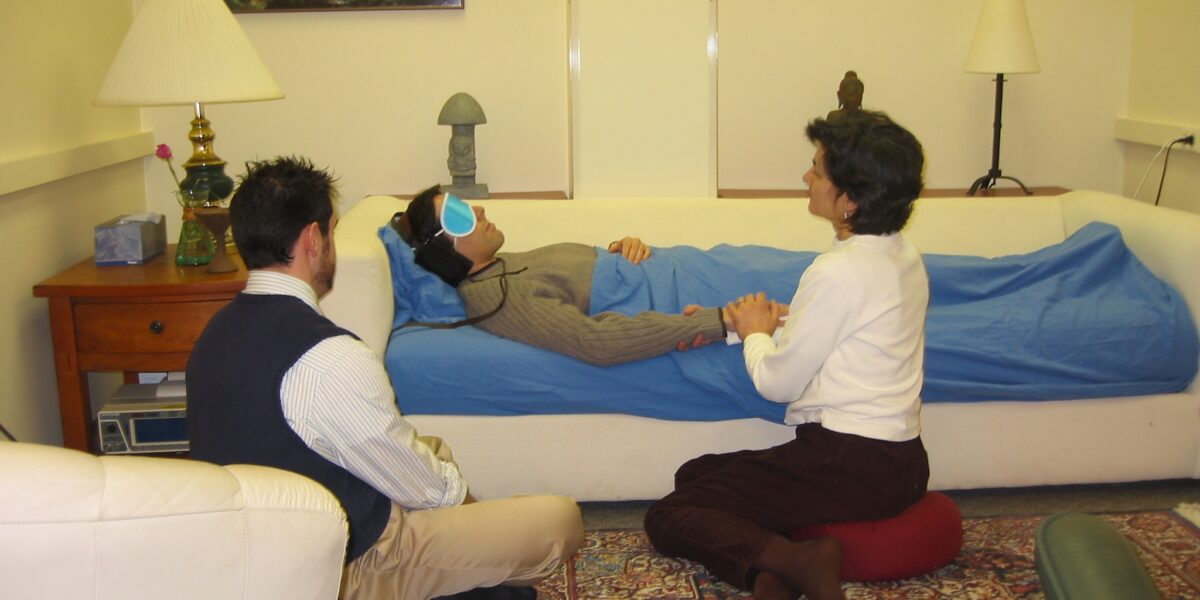
Modern, Westernised yoga nidra is a guided practice in which a teacher (in person or through a recording) guides you through distinct stages of the practice. It’s best practised lying down, with arms out to the side and palms facing up, which is known as savasana, or corpse pose. This can be done on a bed or on a comfortable mat with a pillow under the head and knees for support. The aim is to be able to fully relax the body.

Not all guided yoga nidra is the same. The one recording I rely on is from Insight Timer, led by Jennifer Piercy, which is designed to help you to sleep, although, as mentioned before, I often don’t fall asleep. I’ve tried some other guided recordings and videos, but the spiritual wording, tone, or cadence would often irritate me; the intonation would come across as contrived and overly relaxed, and so, rather than feeling stress-free, I’d just get annoyed. Some people may feel the same about the guided meditation from Insight Timer I shared above, but for me, as someone who is cynical at times, it’s the one I find easiest to relax to.

With the guided yoga nidra I use, as in many others, it involves setting an intention, or sankalpa. This is the reason for practising. For me, it’s nothing too deep: I want to sleep, or at least feel rested. After setting an intention, I follow the breath – the inhalation and exhalation – with some metaphors that the teacher uses to help visualise this natural rhythm. Then, still focusing on the breath, I count back from 10, on the outbreath, until I reach 0. Following this, there’s a full ‘body scan’, in which I place my awareness and attention on a particular part of the body, starting from the throat and ending with the toes.

This body scan then deepens, going from the outside to the inside, trying to place my attention on the layers of the body: the insulating layers, the muscles, bones, organs, and cells. I relax my muscles, try to ‘rest’ my bones, imagine committing my whole body to rest, and watch my heart beat slow down. As well as being deeply relaxing, the body scan is also like a reality check: I never stop to think about my organs, for example – how they’re inside me and working away.

After the body scan, if I’m not already drifting into a half-awake state, I’m instructed to imagine my whole body (or parts of it) feel weightless and floaty, and then, conversely, heavy and sinking; going back and forth between the two, and then imagining my body being both light and heavy at the same time. Following some messages to close the guided meditation, I’ll either feel rested at this point, or I’ve already drifted off and missed some of the recording, or, if I’ve been too distracted by my own thoughts (such as thinking how I really need to sleep), then I might not feel that much different.

Yoga nidra also goes by the name of non-sleep deep rest (NSDR): this is the term that Andrew Huberman coined. It helps to make the technique sound less spiritual or New Agey, making it more palatable to secular ears. This modern, science-oriented label has made deep relaxation techniques more accessible. The practices are essentially the same, though; NSDR is just stripped of spiritual or Sanskrit terminology. The difference is basically in the ‘branding’ of the two.

In addition to the research mentioned before, evidence also suggests yoga nidra can improve mental health and stress levels, as well as help people fall asleep, making it a potentially effective intervention for people struggling with insomnia. NSDR appears to offer a range of emotional, cognitive, and physical benefits.


Yoga Nidra and Hypnagogia

Since yoga nidra can be an effective technique for falling asleep, this also means it can result in hypnagogia. I’ve had many experiences of this, where I’ve not quite fallen asleep, but I’m not in my usual wakeful state. I tune out of the guided meditation and get absorbed by strange phenomena: as I let my body fully relax, the imagination feels more heightened, and then dream-like snippets of voices, conversations, people, or scenarios play out. Hypnagogia has also been referred to as ‘dreamlets’, which I think captures the state quite well – it’s not a full-fledged dream, but it has elements or qualities of dreams. It’s curious how quickly the mind concocts seemingly random and nonsensical images and auditory effects.

One potential benefit of inducing hypnagogia through yoga nidra, as opposed to it occurring naturally when falling asleep, is that being in a more relaxed state could make the hypnagogic hallucinations more pleasant. I don’t recall experiencing unpleasant sensations like someone screaming my name, a door slamming, loud bangs, or suddenly falling off something (and experiencing subsequent hypnic jerks) from yoga nidra-induced hypnagogia. These experiences seem to happen more naturally when falling asleep at night or taking a nap, although I can’t say for certain. I’m also not sure if the hypnagogic material is generally more pleasant when induced through yoga nidra, but I wouldn’t be surprised if it was, owing to feeling more relaxed and stress-free before the onset of these effects.

I wonder, then, if hypnagogia is (at least somewhat) amenable to ‘set and setting’ (mindset and environment), in the way psychedelics are. Could an enhanced mindset and environment make hypnagogic hallucinations more pleasant? Of course, hypnagogia is very distinct from psychedelic effects, so factors related to set and setting may not make much difference. But perhaps research could evaluate this. Does intention-setting, breath awareness, and body relaxation – as used in yoga nidra – change the quality of hypnagogia when it occurs? How does this compare to organically-induced hypnagogia?

The Potential Benefits of Hypnagogia

One of the main potential benefits of hypnagogia that researchers are interested in is enhanced creativity. For example, in the mid-1800s, August Kekulé and other German chemists were trying to figure out the structure of the compound benzene. One day, sitting in front of the fireplace in his apartment in Ghent, Belgium, Kekulé dozed off and saw images that would spur on a monumental scientific discovery. Allison Eck, in an article for Harvard Medicine, writes:

He had had inklings earlier of what benzene might look like, but that day, as he dozed, images hinting at its structure appeared in his mind’s eye. He later wrote that he saw dancing atoms beaded together along an invisible string, “twisting in snake-like motion.” The atoms morphed into an ouroboros: a snake that wrapped itself into a circle, eating its own tail.

The vision was epiphanic. Kekulé realized that benzene’s structure must consist of a ring of carbon atoms, each with a hydrogen atom attached. That revelation would transform scientists’ understanding of biochemistry and allow for advances in many fields, including pharmaceuticals development.

This is an example of how pre-existing mental material (in this case, a problem a scientist has been mulling over) may influence hypnagogic material, or at the very least, how this material is interpreted. Either way, this is an example of hypnagogic-inspired creativity. Eck continues:

Scientists and innovators like Kekulé, Albert Einstein, and Thomas Edison have transited this cerebral pathway in search of solutions to problems. Artists and musicians have siphoned ideas from hypnagogic hallucinations and channeled them into their work. And some writers have experienced what are sometimes referred to as linguistic intrusions during hypnagogia: Vladimir Nabokov references in his memoir Speak, Memory, “a kind of one-sided conversation […] a neutral, detached, anonymous voice,” during an onset of drowsiness.

The neuroscience of hypnagogia is also intriguing, as Eck notes:

On an electroencephalogram, electrical activity during a hypnagogic state looks most similar to electrical activity during the fourth stage of sleep — known by its acronym, REM, due to its signature rapid eye movements. The electrophysiological and phenomenological resemblances between hypnagogia and REM sleep are unexpected. When a person is awakened during stage 1 sleep, a period during which most hypnagogic hallucinations occur, they typically don’t even realize they’ve been asleep. By contrast, REM sleep is the deepest stage of sleep and is fertile ground for intense, more narrative-driven dreams.

Cognitive constraints are loosened in hypnagogic states, but not to the same extent as in REM sleep. And this could be where some unique benefits lie. The neuroscientist Adam Haar Horowitz said, “You’re a different person as you enter sleep onset — you have shifts in the way the brain associates information, but you retain elements of your waking self. You can watch these brain changes happen, watch these hypnagogic microdreams as if from a distance, and with practice, you can change elements of their content.”

Horowitz believes the ability to influence and manipulate hypnagogic content may have useful mental health applications, such as helping veterans and others suffering from PTSD and associated nightmare disorder. Eck writes, “Because studies involving veterans have shown that a perceived lack of control over dreams is correlated with higher insomnia symptoms, a boost in self-efficacy could be a boon to the overall mental health of those experiencing these difficulties.” She highlights other areas of research, such as those being explored by the psychologist Diedre Barrett:

Barrett, for example, points out that hypnagogic hallucinations are often accompanied by sleep paralysis in people with narcolepsy, and because they are frequently jerked in and out of deep sleep, terrifying episodes of hypnagogia can occur for them during a time when their body is immobile. Insights into hypnagogic processes could lead to treatment protocols that might allow people with narcolepsy to better manage their condition.

She adds:

Renowned sleep researcher Rosalind Cartwright, who died in 2021 at the age of 98, coined the concept of the “24-hour mind” in her 2010 book of the same name. It’s an intriguing idea, this proposition that our identities are not just active and evolving while we’re awake but during slumber, too.

Researchers like Horowitz, Barrett, and Carr think that with more exposure to hypnagogic imagery, we might see ourselves in new ways and that, with increased comfort about the possibilities of hypnagogic imagery, society might become more receptive to dream sharing, or to interrogating mental health through the lens of the brain’s neurological nocturnes. Or at the very least, drawing attention to our hypnagogic personas may bring us newfound ideas that we can act on when we wake. For Barrett, who paints many of her dreams and hypnagogic hallucinations, hypnagogia has not only enriched her life — it’s defined her entire career.

Can We Enhance Yoga Nidra-Induced Hypnagogia?

People often struggle to fall asleep after a psychedelic experience is over; the body might be tired, but the mind can still feel active and stimulated. Sometimes, when falling asleep in this post-psychedelic state, or even dozing off as some psychedelic effects are still present, there can be more intense hypnagogic effects. Given some of the potential benefits of hypnagogia noted above, what could be gained by exploring an intensification of hypnagogic hallucinations?

If yoga nidra enhances the quality of these hallucinations, perhaps there is a synergy between practising yoga nidra on psychedelics or in the immediate aftermath of the experience. Not only might this help those struggling to relax or fall asleep following a psychedelic experience, but it might also lead to some interesting, novel, and pleasant hypnagogic states. This could be a way of furthering the creativity-enhancing potential of both psychedelics and hypnagogia. 

Oneirogens are another class of substances that might augment yoga nidra-induced hypnagogia. These are herbs, plants, or chemicals that induce or enhance vivid, dream-like states of consciousness, and which may also intensify dream states themselves, as well as facilitate lucid dreaming. Oneirogens include Calea zacatechichi (also known as Calea ternifolia), traditionally used in Central America for dream divination; mugwort, used in European herbalism; and Silene undulata (also known as Silene capensis, or ‘African dream root’), used by the Xhosa people of South Africa to induce lucid dreams, and which has been found to contain harmala and ibogaine alkaloids

Experimentation and research on the combined use of oneirogens with yoga nidra may show that this leads to synergistic effects – a more effective method for inducing hypnagogia, as well as perhaps more vivid hypnagogic states. However, this (and many of the above considerations) are speculations at this point. Meditators, psychonauts, and oneironauts – as well as researchers in the relevant fields – may be able to discover unique ways of facilitating altered states and enhancing their qualities and benefits. 

Sam Woolfe | Community Blogger at Chemical Collective | www.samwoolfe.com

Sam is one of our community bloggers here at Chemical Collective. If you’re interested in joining our blogging team and getting paid to write about subjects you’re passionate about, please reach out to Sam via email at samwoolfe@gmail.com
share your toughts

Join the Conversation.

0 Comments
Inline Feedbacks
View all comments

Related articles

Our Products

Related Products

1V-LSD 150mcg Blotters
1V-LSD 150mcg Blotters From 22.00
(148)
1cP-LSD 100mcg Blotters
1cP-LSD 100mcg Blotters From 18.00
(139)
Tryptamine Mix and Match Pack (4 x 0.1g)
Tryptamine Mix and Match Pack (4 x 0.1g) 65.00
(1)
1V-LSD 10mcg Micro Pellets
1V-LSD 10mcg Micro Pellets From 15.00
(45)
1V-LSD 225mcg Art Design Blotters
1V-LSD 225mcg Art Design Blotters From 35.00
(65)
1S-LSD 150mcg Blotters
1S-LSD 150mcg Blotters From 29.00
(21)
1V-LSD 225mcg Pellets
1V-LSD 225mcg Pellets From 35.00
(26)
1cP-LSD 10mcg Micro Pellets
1cP-LSD 10mcg Micro Pellets From 15.00
(23)
1D-LSD 225mcg Pellets (1T-LSD)
1D-LSD 225mcg Pellets (1T-LSD) From 42.00
(13)
5-MeO-DMT Freebase
5-MeO-DMT Freebase From 23.95
(36)
O-PCE HCL
O-PCE HCL From 17.50
(25)
1cP-LSD 20mcg Micro Blotters
1cP-LSD 20mcg Micro Blotters From 18.00
(29)
4-HO-MET Powder
4-HO-MET Powder From 19.50
(27)
1cP-LSD 150mcg Pellets
1cP-LSD 150mcg Pellets From 25.00
(13)
4-AcO-MET Fumarate
4-AcO-MET Fumarate From 19.50
(12)
rewards-icon
popup-logo

Reward program

popup-close
  • Earn
  • Affiliates